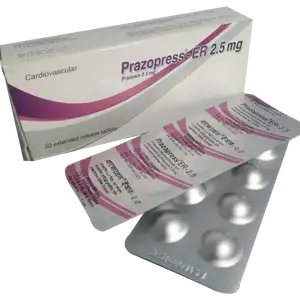
Prazopress-ER 2.5 Tablet (Extended Release)
by UniMed UniHealth Pharmaceuticals Ltd
৳12.00
Renata Pharma Ltd

Prazosin Hydrochloride
Hypertension (Primary and Secondary Hypertension). Raynaud's phenomenon and Raynaud's disease, Congestive heart failure (Prazosin may be used alone or added to the therapeutic regimen in those patients with congestive heart failure who are resistant or refractory to conventional therapy with diuretics and/or cardiac glycosides) & Benign prostatic hyperplasia (For the symptomatic treatment of urinary obstruction due to BPH and in patients awaiting prostatic surgery).
Prazosin causes a decrease in total peripheral vascular resistance through selective inhibition of postsynaptic alpha-1-adrenoreceptors in vascular smooth muscle. In hypertensive patients, blood pressure is lowered in both the supine and standing positions; this effect is more pronounced on the diastolic blood pressure. Rebound elevation of blood pressure does not occur following abrupt cessation of Prazosin therapy. The therapeutic efficacy of Prazosin in patients with congestive heart failure is ascribed to a reduction in left ventricular filling pressure, reduction in cardiac impedance and an augmentation of cardiac output. The use of Prazosin in congestive heart failure does not provoke a reflex tachycardia and blood pressure reduction is minimal in normotensive patients. Prazosin reduces the severity of the signs, symptoms, frequency and duration of attacks, in patients with Raynaud's disease. In low dosage, antagonism of alpha-1-receptors on prostatic and urethral smooth muscle has been shown to improve the urinary pressure profile in men and to improve symptoms of benign prostatic hyperplasia. Clinical studies have shown that Prazosin therapy is not associated with adverse changes in the serum lipid profile.
Hypertension:
Maximum dose: 20 mg in divided doses.
Patients receiving other antihypertensive therapy but with inadequate control:
Congestive heart failure:
Usual daily maintenance dosage: 4 mg to 20 mg in divided doses.
Raynaud's disease:
Usual maintenance dosage: 1 mg or 2 mg twice daily.
Benign prostatic hyperplasia:
The usual maintenance dosage: 2 mg twice daily.
May be taken with or without food. Starting dose is best taken within dinner, at least 2-3 hr before retiring. Maintenance doses may be taken with or without meals.
Use with phosphodiesterase-5 inhibitors (PDE-5 Inhibitors): Concomitant useo f PDE-5 inhibitors (e.g. Sildenafil, Tadalafil, Vardenafil) and Prazosin may lead to symptomatic hypotension in some patients. Adding Prazosin to beta-adrenergic antagonist or calcium antagonist therapy may produce a substantial reduction in blood pressure.
Use with phosphodiesterase-5 inhibitors (PDE-5 Inhibitors): Concomitant useo f PDE-5 inhibitors (e.g. Sildenafil, Tadalafil, Vardenafil) and Prazosin may lead to symptomatic hypotension in some patients. Adding Prazosin to beta-adrenergic antagonist or calcium antagonist therapy may produce a substantial reduction in blood pressure.
The most common side effects of Prazosin are allergic reaction, depression, nervousness, insomnia, Hallucinations, dizziness, drowsiness, headache, faintness, syncope, paraesthesia, worsening of pre-existing narcolepsy, blurred vision, eye pain, reddened sclera, vertigo, tinnitus, palpitations etc.
Pregnancy category C. It should be used only when, in the opinion of the physician, potential benefit outweighs potential risk. Prazosin has been shown to be excreted in small amounts in human milk. Caution should be exercised when Prazosin is administered to nursing mothers.
In patients with benign prostatic hyperplasia: Prazosin is not recommended for patients with a history of micturition syncope. It should not normally be administered to patients already receiving another alpha-1-antagonist.
In patients with congestive heart failure: Prazosin is not recommended in the treatment of congestive cardiac failure due to mechanical obstruction such as aortic valve stenosis, mitral valve stenosis, pulmonary embolism and restrictive pericardial disease.
In patients with hypertension: Postural hypotension evidenced by dizziness and weakness, or rarely loss of consciousness, has been reported, particularly with the commencement of therapy.
Alpha adrenoceptor blocking drugs
Keep away from light and moisture, store below 30° C. Keep away from reach out of the children.
Renata Limited