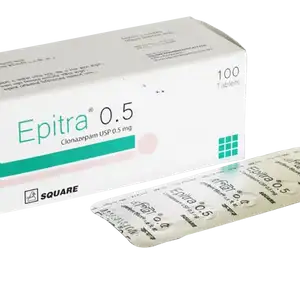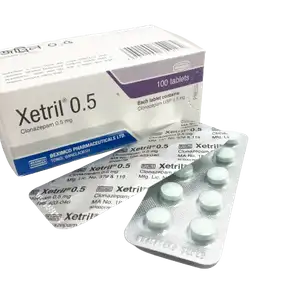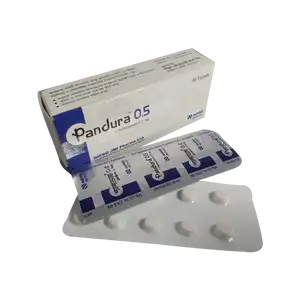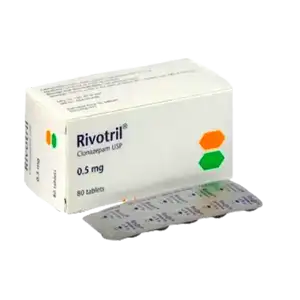
Rivotril 0.5 Tablet
by Radiant Pharmaceuticals Limited
৳9.00
Renata Pharma Ltd
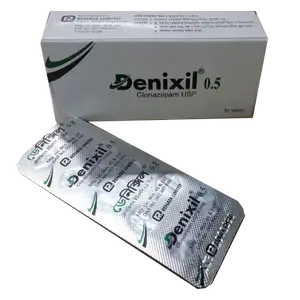
Denixil 0.5 from Renata Limited & Generic is Clonazepam 0.5mg. It is used for the treatment of panic disorder, with or without amnesia. Panic disorder is characterized by the occurrence of sudden panic attacks and involves fear of additional attacks, anxiety about the impact or consequences of attacks.
It is indicated alone or as an adjunct in the treatment of the Lennox-Gastaut Syndrome (petit mal variant), akinetic and myoclonic seizures. It may be indicated in patients with absence seizures (petit mal) who have failed to respond to succinimides.
It is also indicated for the treatment of panic disorder, with or without agoraphobia. Panic disorder is characterized by the occurrence of unexpected panic attacks and associated concern about having additional attacks, worry about the implications or consequences of the attacks.
Clonazepam has benzodiazepine-like pharmacological features, such as anticonvulsive, sedative, muscle relaxing, and anxiolytic actions. Benzodiazepines' central effects are mediated by an increase in GABAergic neurotransmission at inhibitory synapses. The GABA receptor's affinity for the neurotransmitter is increased in the presence of benzodiazepines through positive allosteric modulation resulting in an increased action of released GABA on the postsynaptic transmembrane chloride ion flux. There are also animal data showing an effect of clonazepam on serotonin. Animal data and electroencephalographic investigations in man have shown that clonazepam rapidly suppresses many types of paroxysmal activity including the spike and wave discharge in absences seizures (petit mal), slow spike wave, generalized spike wave, spikes with temporal or other locations as well as irregular spikes and waves. EEG abnormalities in general are repressed more frequently than abnormalities in specific areas. Clonazepam appears to be effective in both widespread and focal epilepsies, according to these data.
Injection:
Infants and children: half of a vial (0.5 mg) by slow IV injection or by IV infusion.
Adults: 1 vial (1 mg) by slow IV injection or by IV infusion. This dose can be repeated as required (1-4 mg are usually sufficient to reverse the status). In adults, the rate of injection must not exceed 0.25 - 0.5 mg per minute (0.5-1.0 ml of the prepared solution) and a total dose of 10 mg should not be exceeded.
Oral:
Adults: The initial dose for adults with seizure disorders should not exceed 1.5 mg/day divided into three doses. Dosage may be increased in increments of 0.5 to 1 mg every 3 days until seizures are adequately controlled or until side effects preclude any further increase. Maintenance dosage must be individualized for each patient depending upon response. Maximum recommended daily dose is 20 mg.
The initial dose for adults with panic disorder is 0.25 mg given in two divided dose. An increase to the target dose for most patients of 1 mg/day may be made after 3 days.
Pediatric Patients: In order to minimize drowsiness, the initial dose for infants and children (up to 10 years of age or 30 kg of body weight) should be between 0.01 and 0.03 mg/kg/day but not to exceed 0.05 mg/kg/day given in two or three divided doses.
Clonazepam does not appear to alter the pharmacokinetics of phenytoin, carbamazepine or phenobarbital. The effect of Clonazepam on the metabolism of other drugs has not been investigated.
It should not be used in patients with a history of hypersensitivity to benzodiazepines, nor in patients with clinical or biochemical evidence of significant liver disease. It may be used in patients with open angle glaucoma who are receiving appropriate therapy but is contraindicated in acute narrow angle glaucoma.
The most frequently occurring side effects of Clonazepam are referable to CNS depression. Experience in treatment of seizures has shown that drowsiness has occurred in approximately 50% of patients and ataxia in approximately 30%. In some cases, these may diminish with time; behavior problems have been noted in approximately 25% of patients. Abnormal eye movements, aphonia, coma, tremor, vertigo, confusion, depression, amnesia, hallucinations, hysteria, increased libido, insomnia, psychosis & palpitations may also occur.
From preclinical studies it cannot be excluded that clonazepam possesses the possibility of producing congenital malformations. From epidemiological evaluations there is evidence that anticonvulsant drugs act as teratogens. However, it is difficult to determine from published epidemiological reports which drug or combination of drugs is responsible for defects in the newborn. The possibility also exists that other factors e.g. genetic factors or the epileptic condition itself may be more important than drug therapy in leading to birth defects. Under these circumstances, the drug should only be administered to pregnant women if the potential benefits outweigh the risk to the foetus. During pregnancy, Clonazepam may be administered only if there is a compelling indication. Administration of high doses in the last trimester of pregnancy or during labour can cause irregularities in the heartbeat of the unborn child and hypothermia, hypotonia, mild respiratory depression and poor feeding in the neonate. It should be borne in mind that both pregnancy itself and abrupt discontinuation of the medication can cause exacerbation of epilepsy. Withdrawal symptoms in newborn infants have occasionally been reported with benzodiazepines.
When used in patients in whom several different types of seizure disorders coexist, Clonazepam may increase the incidence or precipitate the onset of generalized tonic-clonic seizures. This may require the addition of appropriate anticonvulsants or an increase in their dosages. The concomitant use of valproic acid and Clonazepam may produce absence status.
Adjunct anti-epileptic drugs, Benzodiazepine hypnotics
Keep in a dry place away from light and heat. Keep out of the reach of children.

by Healthcare Pharmaceuticals Limited
৳7.00