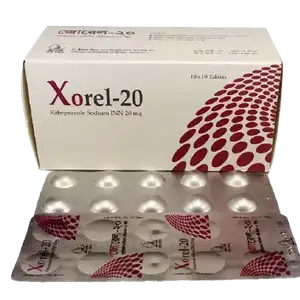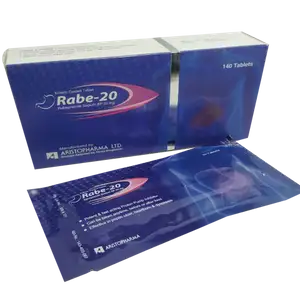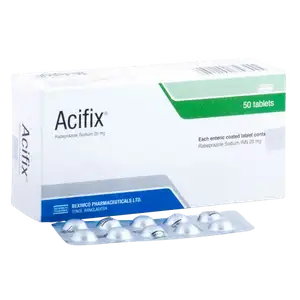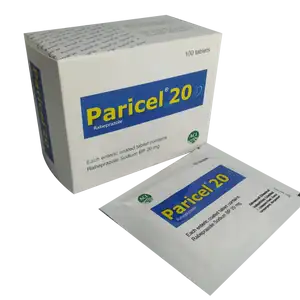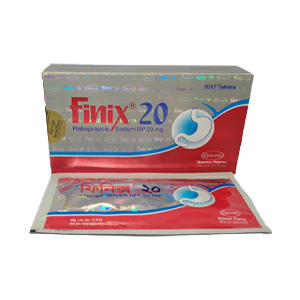
Finix 20 Tablet
by Opsonin Pharma Limited
৳7.00
Opsonin Pharma Limited
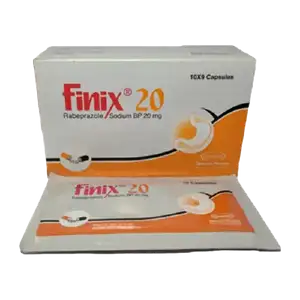
Rabeprazole Sodium
Rabeprazole Gastro-resistant pills are used to treat the following conditions:
By blocking the gastric H+/K+-ATPase at the secretory membrane of the gastric parietal cell, rabeprazole reduces gastric acid production. Rabeprazole has been classified as a gastric proton-pump inhibitor since this enzyme is thought to be the acid (proton) pump within the parietal cell.
Active Duodenal Ulcer and Active Benign Gastric Ulcer: The recommended oral dose for both bioactive duodenal ulcer and active benign gastric ulcer is 20 mg to be taken once daily in the morning. Most patients with active duodenal ulcer heal within four weeks. However, a few patients may require an additional four weeks of therapy to achieve healing. Most patients with active benign gastric ulcer heal within six weeks. However, again a few patients may require an additional six weeks of therapy to achieve healing.
Erosive or Ulcerative Gastro-Esophageal Reflux Disease (GERD): The recommended oral dose for this condition is 20 mg to be taken once daily for four to eight weeks.
Gastro-Esophageal Reflux Disease Long-term Management (GERD Maintenance): For long-term management, a maintenance dose of rabeprazole sodium 20 mg or 10 mg once daily can be used depending upon patient response.
Symptomatic treatment of moderate to very severe Gastro-Esophageal Reflux Disease (symptomatic GERD): 10 mg once daily in patients without oesophagitis. If symptom control has not been achieved during four weeks, the patient should be further investigated. Once symptoms have resolved, subsequent symptom control can be achieved using an on-demand regimen taking 10 mg once daily when needed.
Zollinger-Ellison Syndrome: The recommended adult starting dose is 60 mg once a day. The dose may be titrated upwards to 120 mg/day based on individual patient needs. Single daily doses up to 100 mg/day may be given. 120 mg dose may require divided doses, 60 mg twice daily. Treatment should continue for as long as clinically indicated.
Eradication of H. pylori: Patients with H. pylori infection should be treated with eradication therapy. The following combination given for 7 days is recommended. Rabeprazole sodium 20 mg twice daily, clarithromycin 500 mg twice daily and amoxicillin 1g twice daily.
For indications requiring once-daily treatment Rabeprazole tablets should be taken in the morning, before eating; and although neither the time of day nor food intake was shown to have any effect on rabeprazole sodium activity, this regimen will facilitate treatment compliance. Patients should be cautioned that the Rabeprazole tablets should not be chewed or crushed, but should be swallowed whole.
Respite has a strong and long-lasting inhibitory effect on stomach acid production. It is possible that an interaction with a chemical whose absorption is pH dependant will occur. Rabeprazole sodium in combination with ketoconazole or itraconazole may result in a substantial reduction in antifungal plasma levels. Individual individuals may need to be watched to see if a dose change is required when taking ketoconazole or itraconazole with Respite. There was no interaction with liquid antacids. Atazanavir absorption is pH-dependent. As a result, PPIs, including rabeprazole, should not be used with atazanavir.
Hypersensitivity to the active ingredient or any of the excipients Rabeprazole is not recommended during pregnancy or nursing.
Rabeprazole is generally well tolerated in both short and long-term trials. Rabeprazole may cause headache, diarrhoea, stomach discomfort, vomiting, constipation, dry mouth, increased or reduced appetite, muscular pain, sleepiness, and dizziness in certain people.
Pregnancy category 'C' according to the US Food and Drug Administration. Rabeprazole has been studied in animals, and there has been no indication of decreased fertility or fetal damage as a result of its use. However, no appropriate and well-controlled trials in pregnant women exist. Because rabeprazole is likely to be excreted in human milk, a choice should be taken whether to cease breastfeeding or the medicine, taking into consideration the drug's relevance to the mother.
Severe hypomagnesaemia has been observed in individuals who have been using PPIs like rabeprazole for at least three months, and in most cases for a year. Serious hypomagnesaemia symptoms such as tiredness, tetany, psychosis, convulsions, disorientation, and ventricular arrhythmia can develop, however they may appear gradually and go unnoticed. After magnesium supplementation and cessation of the PPI, hypomagnesaemia improved in the majority of afflicted individuals. Health care practitioners should consider monitoring magnesium levels before commencing PPI medication and frequently during treatment in patients who are likely to be on long-term treatment or who take PPIs with digoxin or medicines that may cause hypomagnesaemia (e.g., diuretics).
Influence on vitamin B12 absorption: Rabeprazole sodium, like many acid-blocking medications, may decrease vitamin B12 (cyanocobalamin) absorption due to hypo- or a- chlorhydria. This should be explored in patients on long-term medication who have low body reserves or risk factors for low vitamin B12 absorption, or if the corresponding clinical signs are seen.
Proton pump inhibitors have been linked to extremely few occurrences of subacute cutaneous lupus erythematosus (SCLE). If lesions appear on the skin, especially in sun-exposed regions, and are accompanied by arthralgia, the patient should seek medical attention immediately, and the health care provider should consider discontinuing Rabeprazole. SCLE following earlier therapy with a proton pump inhibitor may enhance the risk of SCLE with subsequent treatment with another proton pump inhibitor.
Interference with laboratory tests: An elevated Chromogranin A (CgA) level may interfere with neuroendocrine tumor examinations. Rabeprazole 20mg Gastro-resistant Tablets medication should be stopped at least 5 days before CgA readings to avoid this influence. If CgA and gastrin levels have not recovered to the reference range 14 days after stopping proton pump inhibitor medication, tests should be redone.
Inhibitor of the Proton Pump
Keep below 30°C and away from light and moisture. Keep out of children's reach.
Opsonin Pharma Limited
by The IBN SINA Pharmaceutical Industry Ltd.
৳5.00