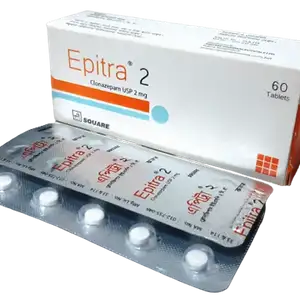
Disopan 2 Tablet
by Incepta Pharmaceuticals Ltd
৳12.50
Delta Pharma Limited

Lonapam 2 Tablet from Delta Pharma Ltd & Generic is Clonazepam 2mg. It is suitable for the treatment of panic disorder, with or without amnesia. Panic disorder is characterized by the occurrence of sudden panic attacks and involves fear of additional attacks, anxiety about the impact or consequences of attacks.
It is prescribed to treat panic disorder, with or without agoraphobia. Panic disorder is defined by the occurrence of unexpected panic episodes and the related fear of experiencing further attacks, as well as anxiety about the implications or repercussions of the attacks.
It is also used alone or in combination to treat Lennox-Gastaut Syndrome (petit mal form), akinetic seizures, and myoclonic seizures. It may be used to treat individuals with absence seizures (petit mal) who have not responded to succinimides.
Clonazepam's efficacy in long-term usage, that is, for more than 9 weeks, has not been well investigated in controlled clinical studies. If a physician decides to use Clonazepam for a lengthy period of time, he or she should reassess the drug's long-term utility for the specific patient on a regular basis.
Clonazepam has benzodiazepine-like pharmacological characteristics, such as anticonvulsant, sedative, muscle relaxing, and anxiolytic actions. The central effects of benzodiazepines are mediated by an increase in GABAergic neurotransmission at inhibitory synapses. The affinity of the GABA receptor for the neurotransmitter is increased in the presence of benzodiazepines via positive allosteric regulation, resulting in greater effect of released GABA on the postsynaptic transmembrane chloride ion flow.
There is additional evidence from animal studies that clonazepam has an influence on serotonin. Clonazepam rapidly suppresses many types of paroxysmal activity, including spike and wave discharge in absence seizures (petit mal), slow spike wave, generalized spike wave, spikes with temporal or other locations, and irregular spikes and waves, according to animal data and electroencephalographic studies in humans. Generalized EEG abnormalities are suppressed more frequently than localized abnormalities. Clonazepam appears to be helpful in both widespread and localized epilepsies, according to these studies.
Oral:
Injection:
Clonazepam appears to have no effect on the pharmacokinetics of phenytoin, carbamazepine, or phenobarbital. Clonazepam's impact on the metabolism of other medications has not been studied.
It should not be taken in individuals who have a history of benzodiazepine hypersensitivity, or in patients who have clinical or biochemical indications of severe liver damage. It is safe to use in individuals with open angle glaucoma who are getting adequate treatment, but it is not safe in people with acute narrow angle glaucoma.
Clonazepam's most common adverse effects are those associated with CNS depression. Drowsiness has been observed in around 50% of individuals treated for seizures, with ataxia occurring in approximately 30%. In some situations, symptoms may fade with time; behavioral issues have been reported in roughly 25% of patients. Aphonia, coma, tremor, vertigo, disorientation, depression, forgetfulness, hallucinations, hysteria, increased libido, sleeplessness, psychosis, and palpitations are all possible side effects.
Pregnancy: Based on preclinical research, it cannot be ruled out that clonazepam may cause congenital abnormalities. There is evidence from epidemiological studies that anticonvulsant medications are teratogens. However, it is impossible to establish which medication or combination of pharmaceuticals is to blame for birth abnormalities based on published epidemiological studies. Other variables, such as hereditary genetics or the epileptic disease itself, may be more important than medication therapy in causing birth abnormalities.Under these conditions, the medication should be given to pregnant women only if the potential benefits outweigh the danger to the fetus. Clonazepam should only be used during pregnancy if there is a compelling reason. High dosages administered in the latter trimester of pregnancy or during labor might induce abnormalities in the unborn child's heartbeat as well as hypothermia, hypotonia, moderate respiratory depression, and poor feeding in the neonate. It should be noted that both pregnancy and sudden withdrawal of medication might result in a worsening of epilepsy. Benzodiazepines have occasionally been linked to withdrawal symptoms in newborn babies.
Nursing Women: Although the active component in Clonazepam has been observed to transfer into breast milk in trace levels, mothers taking this medication should not nurse. If there is a strong need to use Clonazepam, breastfeeding should be stopped.
Clonazepam may increase the incidence or hasten the start of generalized tonic-clonic seizures when taken in individuals with multiple seizure disorders. This may necessitate the inclusion of anticonvulsants or an increase in their doses. Concurrent usage of valproic acid and Clonazepam may result in absent status.
Anti-epileptic medicines in addition to benzodiazepine hypnotics
Keep away from light and heat in a dry area. Keep out of children's reach.

by GENERAL Pharmaceuticals Ltd.
৳10.00