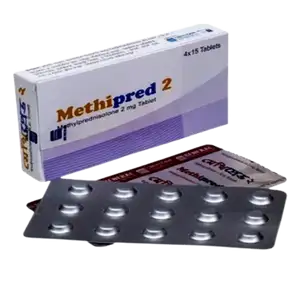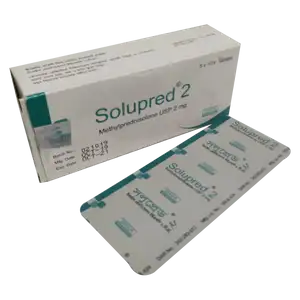
Solupred 2 Tablet
by Ziska Pharmaceuticals Limited
৳3.00
Square Pharmaceuticals Limited
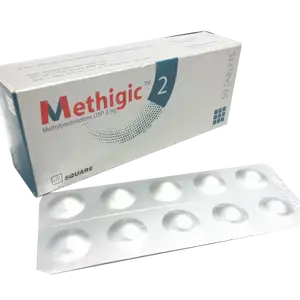
Methylprednisolone
Endocrine Disorders: Primary or Secondary Adrenocortical Insufficiency, Congenital Adrenal Hyperplasia, Nonsuppurative Thyroiditis, Hypercalcemia associated with Cancer;2. Rheumatic
Disorders: Rheumatoid Arthritis, Juvenile Rheumatoid Arthritis, Ankylosing Spondylitis, Acute and Subacute Bursitis, Synovitis of Osteoarthritis, Acute nonspecific Tenosynovitis, Post-traumatic Osteoarthritis, Psoriatic Arthritis, Epicondylitis, Acute Gouty Arthritis; 3. Collagen Diseases: Systemic Lupus Erythematosus, Systemic Dermatomyositis and Acute Rheumatic Carditis; 4. Dermatologic Diseases: Bullous Dermatitis Herpetiformis, Severe Erythema Multiforme (Stevens-Johnson syndrome), Severe Seborrheic Dermatitis, Exfoliative Dermatitis, Mycosis Fungoides, Pemphigus, Severe Psoriasis; 5. Allergy: Seasonal or Perennial Allergic Rhinitis, Drug hypersensitivity reactions, Serum Sickness, Contact Dermatitis, Bronchial Asthma and Atopic Dermatitis; 6. Ophthalmic Diseases: Allergic Corneal Ulcers, Herpes Zoster Ophthalmicus, Anterior segment inflammation, Sympathetic Ophthalmia, Keratitis, Optic Neuritis, Allergic Conjunctivitis, Chorioretinitis, Iritis and Iridocyclitis; 7.
Respiratory Diseases: Symptomatic sarcoidosis, Loeffler’s syndrome not manageable by other means, Berylliosis, Aspiration Pneumonitis; 8. Hematological Disorders: Idiopathic Thrombocytopenic Purpura in adults, Secondary Thrombocytopenia in adults, Acquired (Autoimmune) Hemolytic Anemia, Erythroblastopenia, Congenital (Erythroid) Hypoplastic Anemia; 9.
Neoplastic Diseases: For palliative management of Leukemias and Lymphomas in adults, Acute Leukemia of childhood; 10. Edematous states: To induce a Diuresis or remission of Proteinuria in the Nephrotic Syndrome without Uremia, of the idiopathic type or that due to Lupus Erythematosus; 11. Gastrointestinal Diseases: To tide the patient over a critical period of the disease in Ulcerative Colitis & Regional Enteritis 12. CNS Diseases: Acute Exacerbations of Multiple Sclerosis.
Pharmacodynamic properties: Methylprednisolone Possibly a potent anti-inflammatory agent with significant blocking of the safety framework. Glucocorticoids essentially bind to and activate intracellular glucocorticoid receptors that, when activated, are bound to DMA promoter regions (which can either activate or block translation) and activate translocations code that inactivates substances by reducing histones. Methylprednisolone affects the kidneys, fluids and electrolytes, lipid, protein and carbohydrate digestive system, skeletal muscle, cardiovascular framework, safety frame, fear frame, and endocrine framework.
Pharmacokinetic properties: The maximal bioavailability of methylprednisclone is mainly high (82% to 89%) administered after oral administration and rapid oral administration and peak plasma concentrations are reached about 1.5 to 2 ,3 hours each time the dose administered after the typical verbal organization. strong adults. Methylprednisolone is widely distributed in tissues and has a transport volume of 4,161.5 liters. It crosses the border of the brain and placental obstruction and is discharged into the mammary duct. The competent plasma protein of methylprednisolone in humans is about 77%. Methylprednisolone is metabolised in the liver to inert metabolites. No change in dosage is fundamental for kidney failure. Methylprednisolone is adjustable.
The initial dosage of Methylprednisolone tablets may vary from 2 mg to 48 mg per day depending on the specific disease entity being treated. As anti-inflammatory/immunosuppressive, the initial dosage of Methylprednisolone tablets may vary from 4- 48 mg per day depending on the specific disease entity being treated. In situations of less severity lower doses will generally suffice while in selected patients higher initial doses may be required. The initial dosage should be maintained or adjusted until a satisfactory response is noted. If after a reasonable period of time there is a lack of satisfactory clinical response, Methylprednisolone should be discontinued and the patient transferred to other appropriate therapy. It should be emphasized that dosage requirements are variable and must be individualized on the basis of the disease under treatment and the response of the patient. After a favorable response is noted, the proper maintenance dosage should be determined by decreasing the initial drug dosage in small decrements at appropriate time intervals until the lowest dosage which will maintain an adequate clinical response is reached. It should be kept in mind that constant monitoring is needed in regard to drug dosage. Included in the situations which may make dosage adjustments necessary are changes in clinical status secondary to remissions or exacerbations in the disease process, the patient's individual drug responsiveness and the effect of patient exposure to stressful situations not directly related to the disease entity under treatment; in this latter situation it may be necessary to increase the dosage of Methylprednisolone for a period of time consistent with the patient's condition. If after long-term therapy the drug is to be stopped, it is recommended that it should be withdrawn gradually rather than abruptly. Multiple
Sclerosis: In treatment of acute exacerbations of multiple sclerosis daily doses of 200 mg of prednisolone for a week followed by 80 mg every other day for 1 month have been shown to be effective (4 mg of methylprednisolone is equivalent to 5 mg of prednisolone).
Systemic fungal infections and known hypersensitivity to components.
Short courses of Methylprednisolone are usually well-tolerated with few, mild side effects. Long term, high doses of Methylprednisolone may produce predictable and potentially serious side effects. Whenever possible, the lowest effective doses of Methylprednisolone should be used for the shortest length of time to minimize side effects. Alternate day dosing also can help to reduce side effects. Side effects of Methylprednisolone and other corticosteroids range from mild annoyances to serious irreversible bodily damage. Side effects include fluid retention, weight gain, high blood pressure, potassium loss, headache, muscle weakness, hair growth on the face, glaucoma, cataracts, peptic ulceration, growth retardation in children, convulsions and psychic disturbances including depression, euphoria, insomnia etc. Prolonged use of Methylprednisolone can depress the ability of the body's adrenal glands to produce corticosteroids. Abruptly stopping Methylprednisolone in these individuals can cause symptoms of corticosteroid insufficiency with accompanying nausea, vomiting, and even shock. Therefore, withdrawal of Methylprednisolone usually is accomplished by gradually lowering the dose. Gradually tapering Methylprednisolone not only minimizes the symptoms of corticosteroid insufficiency, it also reduces the risk of an abrupt flare of the disease being treated.
Pregnancy: Category C. Drug should be given only if the potential benefit justifies the potential risk to the foetus. Lactation: Methylprednisolone has not been adequately evaluated in nursing mothers.
Adrenocortical Insufficiency may persist for months after discontinuation of therapy; therefore, in any situation of stress occurring during that period, hormone therapy should be reinstituted. Since mineralocorticoid secretion may be impaired, salt and/or a mineralocorticoid should be administered concurrently. There is an enhanced effect of corticosteroids on patients with hypothyroidism and in those with cirrhosis. Corticosteroids should be used cautiously in patients with ocular herpes simplex because of possible corneal perforation. Aspirin should be used cautiously in conjunction with corticosteroids in hypoprothrombinemia. Growth and development of infants and children on prolonged corticosteroid therapy should be carefully observed.
Glucocorticoids
Store below 30 or Protect from light & moisture. Keep out of the reach of children.
Square Pharmaceuticals Ltd.