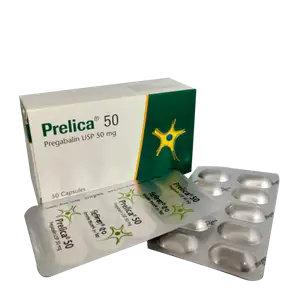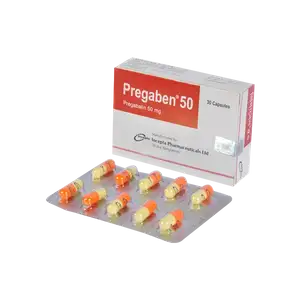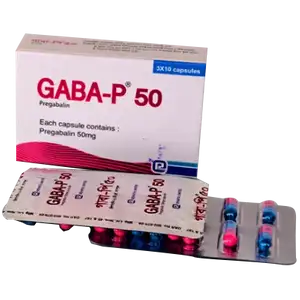
Pregaba 50 Capsule
by Opsonin Pharma Limited
৳15.00
Popular Pharmaceuticals Ltd.

Pregabalin
Pregabalin is prescribed to treat neuropathic pain caused by diabetic peripheral neuropathy.
Post-herpetic neuralgia treatment
Adult patients with partial onset seizures may benefit from adjunctive therapy.
Fibromyalgia is treated in a variety of ways.
Neuropathic pain is a type of pain that occurs after a spinal cord injury.
Pregabalin could be a basic subsidiary of the inhibitory neurotransmitter gamma-amino butyric corrosive (GABA). It does not tie straightforwardly to GABAA, GABAB, or benzodiazepine receptor. Pregabalin ties with tall fondness to the alpha-2-delta location (an assistant subunit of voltage-gated calcium channels) in central anxious framework tissues. Verbal bioavailability of Pregabalin is ≥90% and is autonomous of measurements. It is disposed of from the systemic circulation essentially by renal excretion as unaltered medicate with a cruel end half-life of 6.3 hours in subjects with ordinary renal function.
Neuropathic pain associated with diabetic peripheral neuropathy: The maximum recommended dose of Pregabalin is 100 mg three times a day (300 mg/day) in patients with creatinine clearance of at least 60 mL/min. Dosing should begin at 50 mg three times a day (150 mg/day) and may be increased to 300 mg/day within 1 week based on efficacy and tolerability.
Post-herpetic neuralgia: The recommended dose of Pregabalin is 75 to 150 mg two times a day, or 50 to 100 mg three times a day (150 to 300 mg/day) in patients with creatinine clearance of at least 60 mL/min. Dosing should begin at 75 mg two times a day, or 50 mg three times a day (150 mg/day) and may be increased to 300 mg/day within 1 week based on efficacy and tolerability.Adjunctive therapy for adult patients with partial onset seizures: In general, it is recommended that patients be started on a total daily dose no greater than 150 mg/day (75 mg two times a day, or 50 mg three times a day). Based on individual patient response and tolerability, the dose may be increased to a maximum dose of 600 mg/day.
Management of Fibromyalgia: The recommended dose of Pregabalin for fibromyalgia is 300 to 450 mg/day. Dosing should begin at 75 mg two times a day (150 mg/day) and may be increased to 150 mg two times a day (300 mg/day) within 1 week based on efficacy and tolerability.Neuropathic pain associated with spinal cord injury: The recommended dose range is 150 to 600 mg/day. The recommended starting dose is 75 mg two times a day (150 mg/day). The dose may be increased to 150 mg two times a day (300 mg/day) within 1 week based on efficacy and tolerability.
Pregabalin capsules can be taken without regards to meals.
Pregabalin has no noteworthy interactions with other antiepileptic medicines or oral contraceptives. The effects of ethanol and lorazepam may be amplified by pregabalin.
Patients who have a known hypersensitivity to Pregabalin or any of its components should avoid taking it.
Dizziness, somnolence, dry mouth, edema, blurred vision, weight gain, and aberrant thinking are the most common adverse effects.
Pregabalin has a pregnancy category of C. As a result, it should only be taken if the potential benefit outweighs the dangers to the fetus.
Pregabalin, like other medicines, can pass into the breast milk, thus it should only be used in nursing mothers if the benefits clearly outweigh the risks.
Discontinuation of Pregabalin without tapering may produce insomnia, nausea, headache and diarrhea. So it should be tapered gradually over a minimum of 1 week rather than discontinued abruptly. Creatinine kinase may be elevated if treated with Pregabalin. It should be discontinued rapidly if myopathy is diagnosed or suspected or if creatinine kinase is elevated markedly.
Anti-epileptic medications taken in addition.
Keep away from light and moisture in a cool, dry location (below 30° C). Keep out of children's reach.
Popular Pharmaceuticals Ltd.

by SK+F
৳15.00