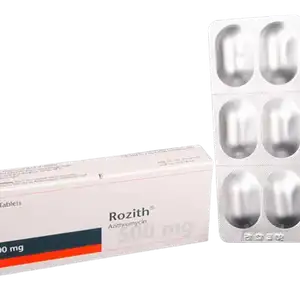
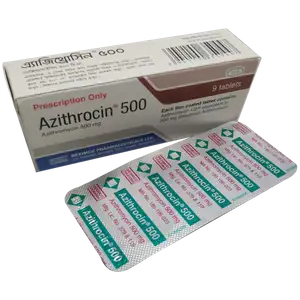
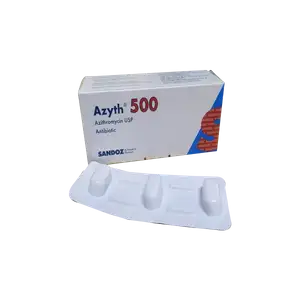
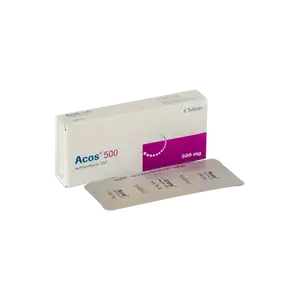
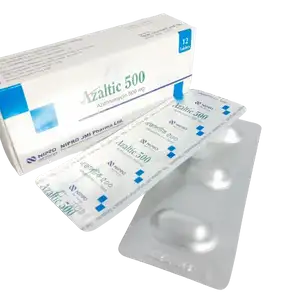
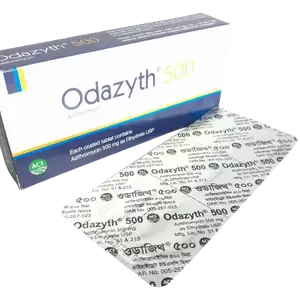
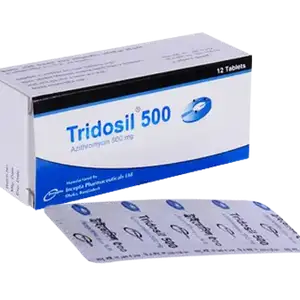
Generic
Azithromycin Dihydrate
Indications
Azithromycin is demonstrated for contaminations (caused by helpless living beings) in lower respiratory tract diseases counting bronchitis and pneumonia, in upper respiratory tract diseases counting sinusitis and pharyngitis/tonsillitis, in otitis media, and in skin and delicate tissue diseases. In sexually transmitted maladies in men and ladies, Azithromycin is demonstrated within the treatment of non-gonococcal urethritis and cervicitis due to Chlamydia trachomatis.
Pharmacology
Azithromycin is acid stable and can then be taken orally without stomach acid reassurance. It is digested over time; Its retention is more noticeable on a purified stomach. The adult peak development time is 2.1 to 3.2 hours for the form measured verbally. Due to the high concentration in phagocytic cells, azithromycin is efficiently transported to the site of contamination. During active phagocytosis, very high concentrations of azithromycin are excreted. The concentration of azithromycin in tissue can be up to 50 times higher than in plasma. This may be due to the high particle uptake and lipid clearance.
The half-life of azithromycin allows prolonged administration of a single measure while maintaining bacteriostatic levels in contaminated tissues for several days. Taken after a single 500 mg measurement, azithromycin plasma concentrations decreased in a polyphasic pattern with a plasma clearance of 630 ml / min and a terminal half-life of 68 hours. The delayed terminal half-life is believed to be due to extensive absorption and the resulting tissue clearance. The virtually unchanged biliary excretion of azithromycin may be a major mode of elimination. Over the course of a week, approximately 6% of the administered figures showed up as unchanged drug in the urine.
Microbiology: Azithromycin acts competently on the 50S ribosomal subunit of vulnerable microorganisms and, therefore, by interferometry with a combination of microbial proteins. Corrosive nucleic acid mixtures are not affected. Azithromycin has been shown to be resistant to most absorption limits after microorganisms, both in vitro and during clinical infection:
Gram-positive microorganisms are highly active and readily cultured: Staphylococcus aureus, Streptococcus agalactiae, Streptococcus pneumoniae, Streptococcus pyogenes facultative: microorganisms Haeemophilis ducreyi, Haemophilus influenzae, Moraxella catarrhalis, Neisseria gonorrhoeae
Other microorganisms: Chlamydia pneumoniae, Chlamydia trachomatis, generation of beta- pneumoniae lactamases are not expected to affect the generation of beta-active azithromycin.
Aerobic and Gram-positive microorganisms: Streptococci (C, F, G beams), Streptococcus viridans Gram-negative aerobic and easily cultured microorganisms: Bordetella pertussis, Legionella pneumophila
Anaerobic microorganisms: Peptostreptococcus species , Prevotella bivia
Dosage
Oral-
Adult:
- 500 mg once day by day orally for 3 days or 500 mg once on day 1, at that point 250 mg once on days 2-5 for 4 days.
- For sexually transmitted maladies caused by Chlamydia trachomatis in grown-ups, the measurements is 1 gm given as a single dosage or 500 mg once on day 1, taken after by 250 mg once every day for following 2 days may too be given.
Children:
- 10 mg/kg body weight once day by day for 3 days for child over 6 months
- 200 mg (1 teaspoonful) for 3 days in case body weight is 15-25 kg
- 300 mg (1½ teaspoonfuls) for 3 days on the off chance that body weight is 26-35 kg; 400 mg (2 teaspoonfuls) for 3 days in the event that body weight is 36-45 kg.
- In typhoid fever, 500 mg (2½ teaspoonfuls) once day by day for 7-10 days is given.
Azithromycin Infusion (For IV Mixture as it were): The suggested dosage of Azithromycin for infusion for the treatment of grown-up patients with community-acquired pneumonia due to the demonstrated living beings is:
- 500 mg as a single every day dosage by the intravenous course for at slightest two days. Intravenous treatment ought to be taken after by Azithromycin by the verbal course at a single, every day measurements of 500 mg, managed as two 250-mg tablets to total a 7 to 10-day course of treatment. The timing of the switch to verbal treatment ought to be done at the watchfulness of the doctor and in agreement with clinical reaction.
- The suggested measurements of Azithromycin for the treatment of grown-up patients with pelvic fiery illness due to the demonstrated living beings is: 500 mg as a single every day dosage by the intravenous course for one or two days. Intravenous treatment ought to be taken after by Azithromycin by the verbal course at a single, every day dosage of 250 mg to total a 7-day course of treatment. The timing of the switch to verbal treatment ought to be done at the caution of the doctor and in understanding with clinical reaction. On the off chance that anaerobic microorganisms are suspected of contributing to the disease, an antimicrobial operator with anaerobic movement ought to be managed in combination with Azithromycin.
- Security and adequacy of azithromycin for infusion in children or teenagers beneath 16 a long time have not been built up.
Administration
Reconstitution method of suspension-
Step 01: Shake the bottle well to extricate the powder.
Step 02: Include bubbled and cooled water up to the water check of the bottle label.
Step 03: Shake until powder is totally blended with water.
Azithromycin ought to be taken at slightest 1 hour some time recently or 2 hours after feast.
Interaction
Azithromycin Infusion (For IV Implantation as it were): The prescribed measurements of Azithromycin for infusion for the treatment of grown-up patients with community-acquired pneumonia due to the demonstrated living beings is: 500 mg as a single day by day dosage by the intravenous course for at slightest two days. Intravenous treatment ought to be taken after by Azithromycin by the verbal course at a single, every day measurements of 500 mg, managed as two 250-mg tablets to total a 7 to 10-day course of treatment. The timing of the switch to verbal treatment ought to be done at the tact of the doctor and in agreement with clinical reaction.
Contraindications
Azithromycin is contraindicated in patients extremely touchy to Azithromycin or any other macrolide anti-microbial. Co-administration of ergot subsidiaries and Azithromycin is contraindicated. Azithromycin is contraindicated in patients with hepatic maladies.
Side Effects
Azithromycin is well endured with a moo frequency of side impacts. The side impacts incorporate queasiness, spewing, stomach distress (pain/cramps), tooting, the runs, cerebral pain, tipsiness, and skin rashes and are reversible upon suspension of treatment.
Pregnancy & Lactation
Pregnancy Category of Azithromycin is B. Creature propagation ponders have illustrated that Azithromycin has no prove of hurt to the hatchling. There are no satisfactory and well controlled considers in pregnant ladies. Since creature generation thinks about are not continuously prescient of human reaction, Azithromycin ought to be utilized amid pregnancy as it were in case satisfactory choices are not accessible. It isn't known whether Azithromycin is emitted in breast drain. So, caution ought to be worked out when Azithromycin is managed to nursing ladies.
Precautions & Warnings
As with any anti-microbial, perception for signs of superinfection with non-susceptible living beings, counting parasites, is prescribed. No measurements alteration is required in patients with renal impedance.
Therapeutic Class
Macrolides
Storage Conditions
Keep in a dry put absent from light and warm. Keep out of the reach of children.
Pharmaceutical Name
Healthcare Pharmaceuticals Ltd.