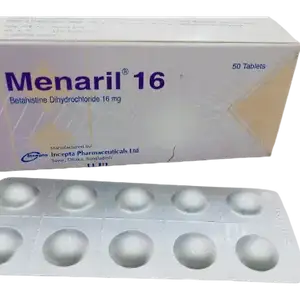
Menaril 16 Tablet
by Incepta Pharmaceuticals Ltd
৳5.00
UniMed UniHealth Pharmaceuticals Ltd

Veserc 16 Tablet from UniMed UniHealth Pharmaceuticals & Generic is Betahistine Dihydrochloride 16mg. Meniere's illness and Meniere-like syndromes are characterized by vertigo, tinnitus, and/or progressive hearing loss, sometimes accompanied by nausea and vomiting.
Meniere's illness and Meniere-like syndromes are characterized by vertigo, tinnitus, and/or progressive hearing loss, sometimes accompanied by nausea and vomiting.
Betahistine has a multifaceted method of action. Meniere's illness is thought to be caused by a breakdown in the ear's endolymphatic fluid equilibrium. Betahistine is primarily an agonist for the histamine H1 receptor. The stimulation of H1-receptors in the inner ear generates a vasodilatory effect in the blood vessels, resulting in enhanced permeability and a reduction in endolymphatic pressure; this action prevents the rupture of the labyrinth, which can contribute to Ménière's disease hearing loss. Betahistine is also thought to relieve symptoms of vertigo by minimizing asymmetrical functioning of sensory vestibular organs and boosting vestibulocochlear blood flow.
In addition to the aforementioned processes, betahistine functions as a histamine H3-receptor antagonist, increasing histamine turnover from postsynaptic histaminergic nerve receptors and, as a result, enhancing H1-agonist activity. H3-receptor antagonism raises levels of neurotransmitters in the brainstem, particularly serotonin, which inhibits vestibular nuclei activity, restoring normal balance and reducing vertigo symptoms.
The usual initial dose: 8 mg to 16 mg three times daily taken preferably with meals.
Maintenance dose: Up to 48 mg daily has been recommended. Betahistine is not recommended for use in children.
There have been no documented occurrences of dangerous interactions. Although a potential antagonism between Betahistine and antihistamines should be expected, no such interactions have been documented.
In pheochromocytoma, betahistine is not recommended.
Betahistine is generally well tolerated, and no major side effects have been reported. Gastrointestinal problems, headaches, rashes, and pruritus have all been reported in rare cases.
In Pregnancy: Although there is no known teratogenic impact in animals, the safety of Betahistine in human pregnancy has not been fully proven. Before administering Betahistine during pregnancy, it's important to weigh the potential advantages carefully.
Betahistine is excreted in similar amounts in the breast milk of nursing mothers as it is in the plasma. The neonate's toxicity at these amounts is unknown.
Patients with bronchial asthma and peptic ulcer disease should be cautious.
Meniere's disease medications
Keep the temperature below 30°C and away from light and moisture. Keep out of children's reach.
UniMed UniHealth Pharmaceuticals Ltd

by Popular Pharmaceuticals Ltd.
৳5.00