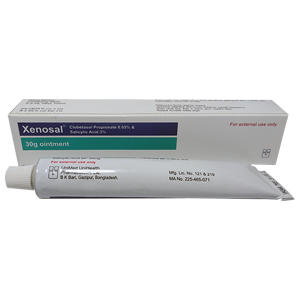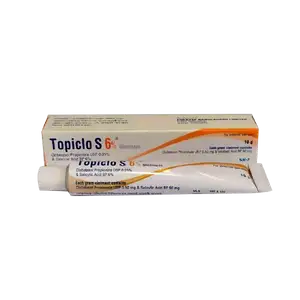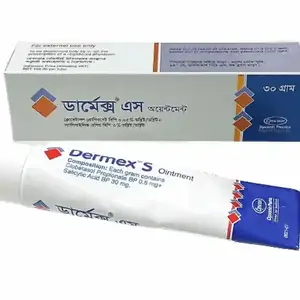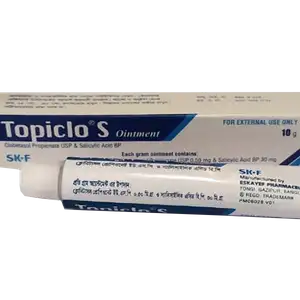
Topiclo S Ointment
by SK+F
৳70.00
Opsonin Pharma Limited
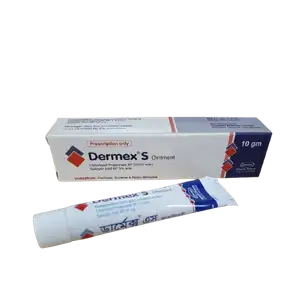
Dermex S 10 from Opsonin Pharma & Generic is Clobetasol Propionate 0.05% + Salicylic Acid 3%. This ointment is indicated for the relief of the inflammatory manifestations of hyperkeratotic and dry corticosteroid responsive dermatoses such as, psoriasis, chronic atopic dermatitis, neurodermatitis (licehen Simplex, Chronicus), lichen planus, eczema (including nummular eczema, hand eczema, eczematous dermatitis), seborrheic dermatitis of the scalp, ichthyosis vulgaris and other ichthyotic conditions.
This ointment is used to treat hyperkeratotic and dry corticosteroid-responsive dermatoses like psoriasis, chronic atopic dermatitis, neurodermatitis (licehen Simplex, Chronicus), lichen planus, eczema (including nummular eczema, hand eczema, eczematous dermatitis), seborrheic dermatitis of the scalp
High-potency corticosteroid Clobetasol Propionate. Corticosteroids reduce inflammation by stabilizing leukocyte lysosomal membranes, preventing the release of destructive acid hydrolases from leukocytes, inhibiting macrophage accumulation in inflamed areas, reducing leukocyte adhesion to capillary endothelium, reducing capillary wall permeability and edema formation, decreasing complement components, and antagonizing histamine activity and kinectin release.
When administered topically, salicylic acid has a strong keratolytic and antiseptic effect. By boosting endogenous hydration, it softens and destroys the stratum corneum, causing the horny layer of the skin to enlarge, soften, and finally desquamate. Salicylic acid has a caustic impact at high concentrations. It also has some antifungal and antibacterial properties.
Clobetasol Propionate ointment and cream have not been reported to interact. When taken as directed, Salicylic Acid has no known interactions. Topical salicylic acid, on the other hand, may enhance the absorption of other topically administered drugs. Salicylic Acid Ointment and other topical medicines should not be used on the same area of skin at the same time.
ClobetasolPropionatev is not recommended for people who are allergic to Clobetasol Propionate. This medication is also contraindicated in the treatment of primary infected bacterial or fungal skin lesions when no anti-infective therapy is administered at the same time, in primary cutaneous viral infections (such as herpes simplex, vaccinia, and varicella), and in tuberculous skin lesions. Clobetasol Propionate is also contraindicated in children under the age of one year with dermatoses such as dermatitis and diaper eruptions. In individuals with salicylate hypersensitivity or sensitivity to any other constituent in the preparation, salicylic acid is contraindicated.
Long-term use of significant doses of Clobetasol Propionate or treatment of vast areas, like with other topical corticosteroids, can result in enough systemic absorption to cause hypercortisolism. If occlusive dressings are used, this result is more likely to occur in infants and children. After a long period of treatment, local atrophy may ensue. Treatment of psoriasis with corticosteroids (or their discontinuation) is suspected to have triggered the pustular form of the illness in a few cases. Clobetasol Propionate is normally well tolerated, but if hypersensitivity symptoms arise, discontinue use immediately.When taking Salicylic Acid, there is a risk of hypersensitive reactions, dryness, and irritation.
Corticosteroids used topically to pregnant animals can cause fetal development problems. The applicability of this discovery to humans has yet to be determined. Clobetasol Propionate has not been proven to be safe during lactation. Clobetasol Propionate administration during pregnancy and lactation, on the other hand, should only be considered if the predicted benefit to the mother outweighs any potential harm to the fetus. This class of drugs should not be used in large dosages or for long periods of time in pregnant individuals.Although there are no known contraindications to using Salicylic Acid ointment during pregnancy or lactation, its safety has yet to be determined. As a result, salicylic acid ointment should be used with caution.
Not to be used in high quantities or on significant portions of the body for an extended period of time. Diabetes or impaired peripheral circulation. Broken skin, mouth, eyes, mucous membranes, and the anogenital region should all be avoided.
Store in a cold, dry, and light-protected location.
by Square Pharmaceuticals Limited
৳150.00