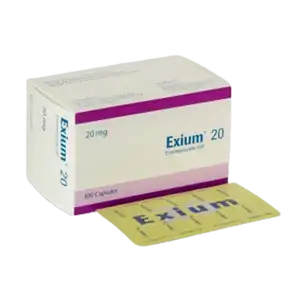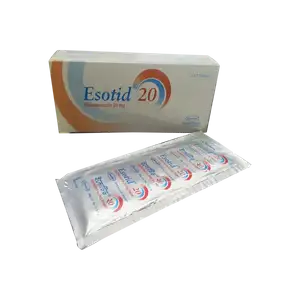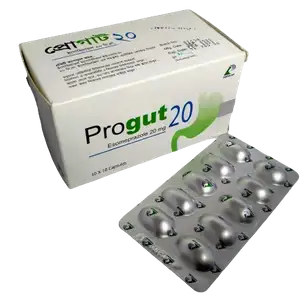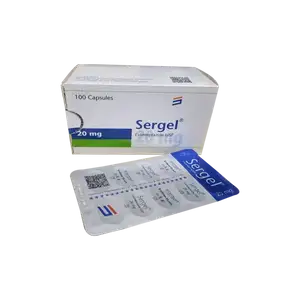
Sergel 20 Capsule
by Healthcare Pharmaceuticals Limited
৳7.00
Incepta Pharmaceuticals Ltd

Esonix 20 mg Tablet by Incepta pharmaceutical Ltd is available in our online pharmacy. Place your order in osudpotro and get online medicine home delivery.
Esomeprazole is indicated:
Esomeprazole is a proton pump inhibitor that suppresses gastric acid secretion by specific inhibition of the H+/K+-ATPase in the gastric parietal cell. Esomeprazole (S-isomer of omeprazole) is the first single optical isomer of proton pump inhibitor, provides better acid control than racemic proton pump inhibitors.
Absorption: Esomeprazole capsules contain an enteric-coated pellet formulation of esomeprazole magnesium. After oral administration peak plasma levels (Cmax) occur at approximately 1.5 hours (Tmax). The Cmax increases proportionally when the dose is increased, and there is a three-fold increase in the area under the plasma concentration-time curve (AUC) from 20 to 40 mg. At repeated once-daily dosing, the systemic bioavailability is approximately 90% compared to 64% after a single dose. The AUC after administration of a single dose of esomeprazole is decreased by 33-53% after food intake compared to fasting conditions. Esomeprazole should be taken at least one hour before meals.
Distribution: Esomeprazole is 97% bound to plasma proteins. Plasma protein binding is constant over the concentration range of 2 20 mmol/L. The apparent volume of distribution at a steady state in healthy volunteers is approximately 16 L.
Metabolism: Esomeprazole is extensively metabolized in the liver by the cytochrome P450 (CYP) enzyme system. The metabolites of esomeprazole lack anti-secretory activity. The major part of esomeprazole’s metabolism is dependent upon the CYP2C19 isoenzyme, which forms the hydroxy and dimethyl metabolites. The remaining amount is dependent on CYP3A4 which forms the sulphone metabolite.
Excretion: The plasma elimination half-life of esomeprazole is approximately 1–1.5 hours. Less than 1% of the parent drug is excreted in the urine. Approximately 80% of an oral dose of esomeprazole is excreted as inactive metabolites in the urine, and the remainder is found as inactive metabolites in the face.
Combination Therapy with Antimicrobials: Esomeprazole magnesium 40 mg once daily is given in combination with clarithromycin 500 mg twice daily and amoxicillin 1000 mg twice daily for 7 days. The mean steady-state AUC and Cmax of Esomeprazole increased by 70% and 18%, respectively, during triple combination therapy compared to treatment with Esomeprazole alone. The pharmacokinetic parameters for clarithromycin and amoxicillin are similar during triple combination therapy and administration of each drug alone. However, the mean AUC and Cmax for 14-hydroxyclarithromycin are increased by 19% and 22%, respectively, during triple combination therapy compared to treatment with clarithromycin alone. This increase in exposure to 14-hydroxyclarithromycin is not considered to be clinically significant.
Healing of Erosive Esophagitis: 20 mg or 40 mg Once Daily for 4-8 Weeks. The majority of patients are healed within 4 to 8 weeks. For patients who don't heal after 4-8 weeks, an additional 4-8 weeks of treatment may be considered. Maintenance of Healing of Erosive
Esophagitis: 20 mg Once Daily (Clinical studies did not extend 6 months).
Symptomatic GERD: 20 mg Once Daily for 4 Weeks. If symptoms do not resolve completely after 4 weeks, an additional 4 weeks of treatment may be considered.
Helicobacter Pylori eradication: Triple Therapy to reduce the risk of Duodenal Ulcer recurrence-Esomeprazole 40 mg Once Daily for 10 days, Amoxicillin 1000 mg Twice Daily for 10 days, Clarithromycin 500 mg Twice Daily for 10 days.
Zollinger-Ellison Syndrome: The dose is 20-80 mg once daily. The dosage should be adjusted individually and treatment continued as long as clinically indicated.
Acid-related Dyspepsia: 20-40 mg once daily for 2-4 weeks according to the response.
Duodenal ulcer: 20 mg once daily for 2-4 weeks. Gastric ulcer: 20-40 mg once daily for 4-8 weeks.
Injection: The recommended adult dose is 40 mg Esomeprazole given once daily by intravenous injection (not less than 3 minutes) or intravenous infusion (10 to 30 minutes). Esomeprazole IV injection should not be administered concomitantly with any other medications through the same intravenous site. Treatment with Esomeprazole IV injection should be discontinued as soon as the patient is able to resume treatment with Esomeprazole delayed-release capsules. Safety and effectiveness in pediatric patients have not been established.
Esomeprazole tablet or capsule: should be swallowed whole and taken one hour before a meal.
Direction for use of Delayed-Release Oral Suspension: Whole contents of the packet should be taken into a small glass containing 15 ml. of water. The mixer should be stirred well and leave 2 to 3 minutes to thicken. Stir again and drink within 30 minutes. If any medicine remains after drinking, add more water, stir, and drink immediately. If the suspension is to be administered through a nasogastric or gastric tube, the volume of water in the syringe should be 15 ml. & immediately shake the syringe and leave 2 to 3 minutes to thicken. Shake the syringe and inject it through the nasogastric or gastric tube into the stomach within 30 minutes. An appropriately sized syringe should be used. Shake and flush any remaining contents from the nasogastric or gastric tube into the stomach.
Esomeprazole IV Injection: Esomeprazole IV should be given as a slow intravenous injection. The solution for IV injection is obtained by adding to the vial 5 ml of the solvent (WFI) provided. After reconstitution, the injection should be given slowly over a period of at least 3 minutes. The solution should be used within 12 hours of reconstitution when stored at room temperature up to 30°C. No refrigeration is required. The reconstituted solution should not be used if it contains visible particulate.
Esomeprazole is extensively metabolized in the liver by CYP2C19 and CYP3A4. In vitro and in vivo studies have shown that Esomeprazole is not likely to inhibit CYPs 1A2, 2A6, 2C9, 2D6, 2E1, and 3A4. No clinically relevant interactions with drugs metabolized by these CYP enzymes would be expected. Drug interaction studies have shown that Esomeprazole does not have any clinically significant interactions with phenytoin, warfarin, quinidine, clarithromycin, or amoxicillin.
Esomeprazole may potentially interfere with CYP2C19, the major Esomeprazole metabolizing enzyme. Co-administration of Esomeprazole 30 mg and diazepam, a CYP2C19 substrate has resulted in a 45% decrease in clearance of diazepam. Increased plasma levels of diazepam have been observed 12 hours after dosing and onwards. Esomeprazole inhibits gastric acid secretion. Therefore, Esomeprazole may interfere with the absorption of drugs where gastric pH is an important determinant of bioavailability (e.g., ketoconazole, iron salts, and digoxin).
Co-administration of oral contraceptives, diazepam, phenytoin, or quinidine does not seem to change the pharmacokinetic profile of Esomeprazole.
Combination Therapy with Clarithromycin: Co-administration of esomeprazole, clarithromycin, and amoxicillin has resulted in increases in the plasma levels of esomeprazole and 14-hydroxyclarithromycin.
In patients who have a history of hypersensitivity to any of the formulations, esomeprazole is not recommended.
Headache, diarrhea, nausea, flatulence, abdominal pain, constipation, and dry mouth are some of the most common side effects associated with Esomeprazole. When comparing maintenance treatment for up to 12 months to short-term treatment, there is no difference in the types of associated side events seen.
In pregnant women, there are no sufficient and well-controlled trials. No teratogenic effects have been found in animal investigations. Esomeprazole excretion in milk has not been studied. If the use of esomeprazole is thought necessary, breastfeeding should be terminated.
Common: Symptomatic reaction to treatment with esomeprazole does not block the nearness of gastric malignancy. Information for patients: Esomeprazole capsules ought to be taken at slightest one hour some time recently suppers. For patients who have trouble gulping capsules, one tablespoon of applesauce can be included in a purge bowl and the Esomeprazole capsules can be opened, and the interior of the pellet the capsule carefully purged onto the applesauce. The pellets ought to be blended with the applesauce and after that gulped promptly. The applesauce utilized ought to not be hot and ought to be delicate sufficient to be gulped without chewing. The pellets ought to not be chewed or smashed. The pellet/applesauce blend ought to not be put away for future utilize. Stomach settling agents may be utilized whereas taking esomeprazole.
Proton Pump Inhibitor
Keep the temperature below 30°C and away from light and moisture. Keep out of children's reach.
Esomeprazole Magnesium Trihydrate
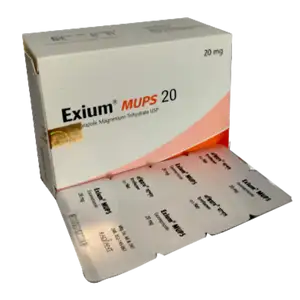
by Radiant Pharmaceuticals Limited
৳11.00