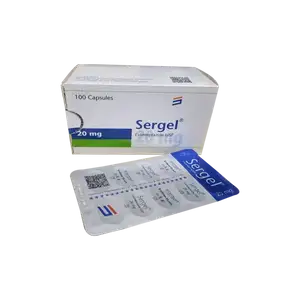
Sergel 20 Capsule
by Healthcare Pharmaceuticals Limited
৳7.00
Renata Pharma Ltd
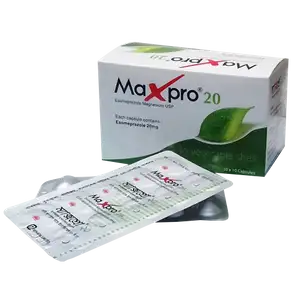
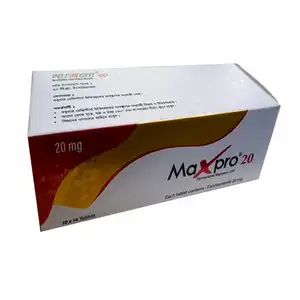
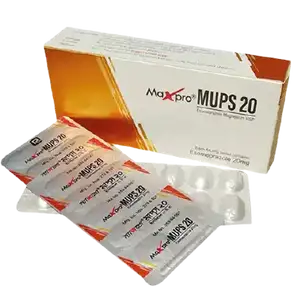
Maxpro 20 mg Capsule by Renata pharmaceutical Ltd is available in our Trusted medicine store. Place your order in osudpotro and get the best Price online medicine home delivery in Bangladesh.
Esomeprazole is endorsed to treat persistent acid reflux and other GERD symptoms.
Esomeprazole may be a proton pump inhibitor that represses the H+/K+-ATPase within the gastric parietal cell, stifling gastric corrosive yield. The primary single optical isomer of a proton pump inhibitor, esomeprazole (S-isomer of omeprazole), gives predominant corrosive control than racemic proton pump inhibitors.
Esomeprazole capsules contain an enteric-coated pellet form of esomeprazole magnesium for progressed retention. Crest plasma levels (Cmax) happen generally 1.5 hours after verbal dosing (Tmax). When the measurements is expanded, the Cmax increments correspondingly, and the zone beneath the plasma concentration-time bend (AUC) increments thrice from 20 to 40 mg. The systemic bioavailability with rehashed once-daily measurements is around 90%, compared to 64% after a single dosage. When compared to fasting conditions, the AUC taking after a single dose of esomeprazole is diminished by 33-53 percent after nourishment ingestion. At slightest one hour some time recently suppers, esomeprazole ought to be expended.
Esomeprazole ties to plasma proteins 97 percent of the time. Over a concentration extend of 2 20 mmol/L, plasma protein official remains steady. In sound volunteers, the clear volume of conveyance at unfaltering state is around 16 L.
Esomeprazole is broadly prepared by the cytochrome P450 (CYP) chemical framework within the liver. Esomeprazole's metabolites have no anti-secretory properties. The CYP2C19 isoenzyme, which makes the hydroxy and desmethyl metabolites, is capable for the lion's share of esomeprazole digestion system. The sulphone metabolite is shaped by CYP3A4, which is capable for the remaining extent.
Combination Treatment with Antimicrobials: Esomeprazole magnesium 40 mg once day by day is given in combination with clarithromycin 500 mg twice day by day and amoxicillin 1000 mg twice day by day for 7 days. The cruel relentless state AUC and Cmax of Esomeprazole expanded by 70% and 18%, individually, amid triple combination treatment compared to treatment with Esomeprazole alone. The pharmacokinetic parameters for clarithromycin and amoxicillin are comparable amid triple combination treatment and organization of each medicate alone. Be that as it may, the cruel AUC and Cmax for 14-hydroxyclarithromycin are expanded by 19% and 22%, separately, amid triple combination treatment compared to treatment with clarithromycin alone. This increment in introduction to 14-hydroxyclarithromycin isn't considered to be clinically noteworthy.
Healing of Erosive Esophagitis: 20 mg or 40 mg Once Daily for 4-8 Weeks. The majority of patients are healed within 4 to 8 weeks. For patients who don't heal after 4-8 weeks, an additional 4-8 weeks of treatment may be considered. Maintenance of Healing of Erosive
Esophagitis: 20 mg Once Daily (Clinical studies did not extend 6 months).
Symptomatic GERD: 20 mg Once Daily for 4 Weeks. If symptoms do not resolve completely after 4 weeks, an additional 4 weeks of treatment may be considered.
Helicobacter Pylori eradication: Triple Therapy to reduce the risk of Duodenal Ulcer recurrence-Esomeprazole 40 mg Once Daily for 10 days, Amoxicillin 1000 mg Twice Daily for 10 days, Clarithromycin 500 mg Twice Daily for 10 days.
Zollinger-Ellison Syndrome: The dose is 20-80 mg once daily. The dosage should be adjusted individually and treatment continued as long as clinically indicated.
Acid-related Dyspepsia: 20-40 mg once daily for 2-4 weeks according to the response.
Duodenal ulcer: 20 mg once daily for 2-4 weeks. Gastric ulcer: 20-40 mg once daily for 4-8 weeks.
Injection: The recommended adult dose is 40 mg Esomeprazole given once daily by intravenous injection (not less than 3 minutes) or intravenous infusion (10 to 30 minutes). Esomeprazole IV injection should not be administered concomitantly with any other medications through the same intravenous site. Treatment with Esomeprazole IV injection should be discontinued as soon as the patient is able to resume treatment with Esomeprazole delayed-release capsules. Safety and effectiveness in paediatric patients have not been established.
Esomeprazole tablet or capsule: should be swallowed whole and taken one hour before a meal.
Direction for use of Delayed-Release Oral Suspension: Whole contents of the packet should be taken into a small glass containing 15 ml. of water. The mixer should be stirred well and leave 2 to 3 minutes to thicken. Stir again and drink within 30 minutes. If any medicine remains after drinking, add more water, stir, and drink immediately. If the suspension is to be administered through a nasogastric or gastric tube, the volume of water in the syringe should be 15 ml. & immediately shake the syringe and leave 2 to 3 minutes to thicken. Shake the syringe and inject it through the nasogastric or gastric tube into the stomach within 30 minutes. An appropriately sized syringe should be used. Shake and flush any remaining contents from the nasogastric or gastric tube into the stomach.
Esomeprazole IV Injection: Esomeprazole IV should be given as a slow intravenous injection. The solution for IV injection is obtained by adding to the vial 5 ml of the solvent (WFI) provided. After reconstitution, the injection should be given slowly over a period of at least 3 minutes. The solution should be used within 12 hours of reconstitution when stored at room temperature up to 30°C. No refrigeration is required. The reconstituted solution should not be used if it contains visible particulate.
Esomeprazole is broadly metabolized within the liver by CYP2C19 and CYP3A4. In vitro and in vivo considers have shown that Esomeprazole isn't likely to restrain CYPs 1A2, 2A6, 2C9, 2D6, 2E1 and 3A4. No clinically pertinent intelligent with drugs metabolized by these CYP proteins would be anticipated. Sedate interaction thinks about have appeared that Esomeprazole does not have any clinically noteworthy intuitive with phenytoin, warfarin, quinidine, clarithromycin or amoxicillin.
Esomeprazole may possibly meddled with CYP2C19, the major Esomeprazole metabolizing protein. Co-administration of Esomeprazole 30 mg and diazepam, a CYP2C19 substrate has brought about in a 45% diminish in clearance of diazepam. Expanded plasma levels of diazepam have been watched 12 hours after dosing and onwards. Esomeprazole hinders gastric corrosive emission. In this manner, Esomeprazole may meddled with the retention of drugs where gastric pH is an vital determinant of bioavailability (e.g., ketoconazole, press salts and digoxin).
Co-administration of verbal contraceptives, diazepam, phenytoin, or quinidine don't appear to alter the pharmacokinetic profile of Esomeprazole.
Esomeprazole is contraindicated in-patient with known extreme touchiness to any of the definition.
Migraine, the runs, sickness, tooting, stomach torment, stoppage, and dry mouth are the foremost common side impacts detailed with Esomeprazole. When compared to short-term treatment, there's no distinction within the categories of connected unfavorable occasions taken note with support treatment up to 12 months.
There are no satisfactory and well-controlled considers in pregnant ladies. Creature thinks about have uncovered no teratogenic impacts. The excretion of esomeprazole in drain has not been examined. Breast-feeding ought to be in this manner be suspended in the event that the utilize of esomeprazole is considered basic.
Common: Symptomatic reaction to treatment with esomeprazole does not block the nearness of gastric malignancy.
Proton Pump Inhibitor
Store at a temperature not exceeding 30°C in a dry place. Protect from light and moisture. Keep out of reach of children.
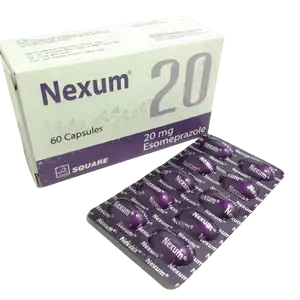
by Square Pharmaceuticals Limited
৳7.02