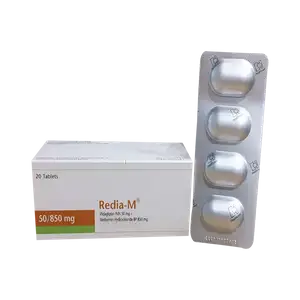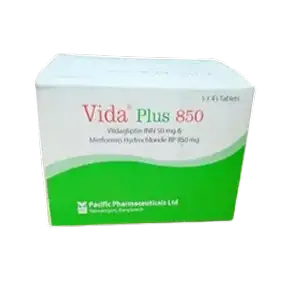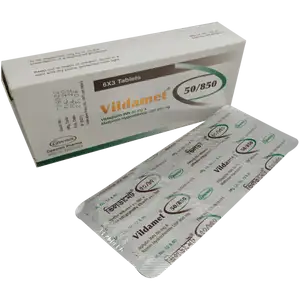
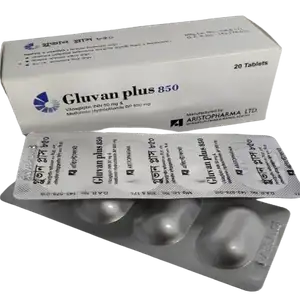
Vildamet 50/850 Tablet
by Opsonin Pharma Limited
৳24.00
Aristopharma Ltd.
Vildagliptin + Metformin Hydrochloride
Patients with type 2 diabetes mellitus who are not adequately controlled on Metformin Hydrochloride or Vildagliptin alone, or who are already treated with the combination of Vildagliptin and Metformin Hydrochloride as separate tablets, should take this tablet as an adjunct to diet and exercise to improve glycaemic control.
Vildagliptin works by blocking DPP-4 (Dipeptidyl peptidase-4), an enzyme that breaks down the incretin hormones GLP-1 (glucagon-like peptide-1) and GIP (glucagon-like peptide-2) (glucose-dependent insulinotropic polypeptide). Vildagliptin inhibits DPP-4 activity quickly and completely, resulting in higher endogenous levels of the incretin hormones GLP-1 and GIP during fasting and postprandial periods. Vildagliptin enhances insulin secretion from the pancreatic beta cell while decreasing glucagon secretion from the alpha cell by boosting endogenous levels of these incretin hormones. Increased incretin hormone levels cause a rise in the insulin/glucagon ratio during hyperglycemia, which leads to a decrease in fasting and postprandial hepatic glucose production, resulting in lower glycemia.
Metformin Hydrochloride is an antihyperglycemic medication of the biguanide class that is used to treat type 2 diabetes. Both baseline and postprandial plasma glucose levels are reduced. It has a different mode of action than sulfonylureas and does not cause hypoglycemia. By increasing peripheral glucose uptake and utilization, glucomin lowers hepatic glucose synthesis, lowers intestinal glucose absorption, and increases insulin sensitivity.
Adults: This combination may be started twice daily, with one pill in the morning and the other in the evening, depending on the patient's existing Metformin dose. Patients who are already taking Vildagliptin and Metformin as separate pills may be switched to this combination, which has the same doses of both drugs. Vildagliptin doses greater than 100 mg are not recommended. Vildagliptin and Metformin in triple combination with other antidiabetic medications have not been studied in humans. Metformin-related gastrointestinal problems may be reduced by taking this combination with or just after eating.
When Vildagliptin (100 mg once day) was combined with Metformin Hydrochloride, no clinically significant pharmacokinetic interaction was identified (1,000 mg once daily). Drug interactions are unlikely with Vildagliptin. Vildagliptin is unlikely to interact with co-medications that are substrates, inhibitors, or inducers of cytochrome P (CYP) 450 enzymes because it is not a CYP 450 enzyme substrate, inhibitor, or inducer. After co-administration of vildagliptin with other oral antidiabetics (glibenclamide, pioglitazone, metformin hydrochloride), amlodipine, digoxin, ramipril, simvastatin, valsartan, or warfarin, no clinically meaningful interactions were detected. Furosemide, nifedipine, and glyburide, on the other hand, raise Metformin Cmax and blood AUC while having no effect on Metformin renal clearance.
Patients who have a known hypersensitivity to Vildagliptin, Metformin Hydrochloride, or any of the excipients should avoid this combination. It's not recommended for people who have kidney illness or malfunction, a heart attack, or septicaemia. It's also not recommended for people who have congestive heart failure or who have acute or chronic metabolic acidosis, such as diabetic ketoacidosis, with or without coma. It should be temporarily stopped in patients undergoing radiologic examinations that require intravascular administration of iodinated contrast materials, as such products can cause acute renal dysfunction.
Headache, tremor, dizziness, nausea, hypoglycemia, and other side effects are the most common.
Because there are no good and well-controlled studies in pregnant women, this combination should not be taken during pregnancy unless the possible benefit outweighs the risk to the fetus. There have been no research done on the components of this combination. This combination should not be given to breast-feeding women because it is unknown whether Vildagliptin and/or Metformin Hydrochloride are excreted in human milk.
Metformin buildup can cause lactic acidosis. If metabolic acidosis is suspected, medication should be stopped promptly and the patient admitted to the hospital. Patients with normal renal function should have their serum creatinine levels checked at least once a year, while patients with serum creatinine levels over the upper limit of normal and elderly patients should have their serum creatinine levels checked 2–4 times a year. In older patients with poor renal function, more vigilance should be observed (e.g. when initiating antihypertensives, diuretics or NSAIDs). Liver Function Tests (LFTs) should be monitored prior to starting this medication, at three-monthly intervals for the first year, and then on a regular basis following that. If transaminase levels rise, patients should have a second liver function test to confirm the result, and then be monitored with periodic liver function tests until the aberration returns to normal. Patients who develop jaundice or other indicators of liver impairment should discontinue using Vildagliptin and Metformin tablets if their AST or ALT levels remain at 3 times the upper limit of normal. Treatment with Vildagliptin & Metformin should not be restarted after LFT normalization and discontinuation of Vildagliptin & Metformin. Vildagliptin and Metformin tablets should be stopped 48 hours before any elective operation requiring general anaesthetic, and should not be restarted for another 48 hours.
Oral hypoglycemic medications in combination.
Keep away from light and heat in a dry location. Keep out of children's reach.
Aristopharma Ltd.