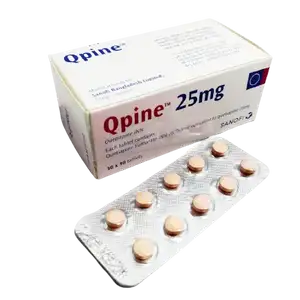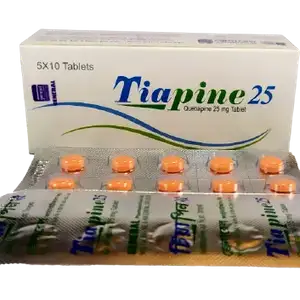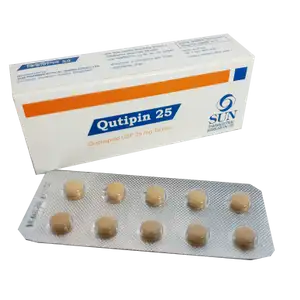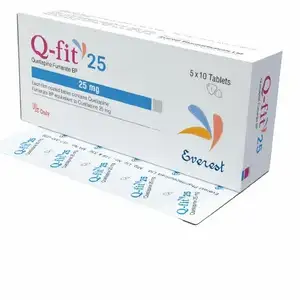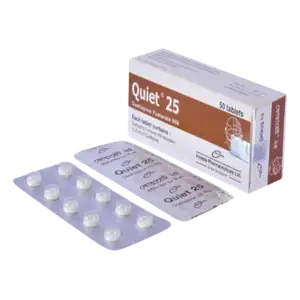
Quiet 25 Tablet
by Incepta Pharmaceuticals Ltd
৳3.00
UniMed UniHealth Pharmaceuticals Ltd
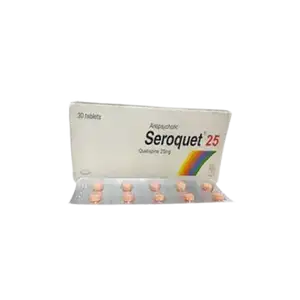
Quetiapine Fumarate
Quetiapine is used to treat acute and chronic psychoses, such as schizophrenia, as well as bipolar disorder, including: treatment of manic episodes that meet DSM-IV criteria for mania in bipolar disorder, treatment of depressive episodes in bipolar disorder, and maintenance treatment of bipolar I disorder in combination with a mood stabilizer to prevent relapse.
The mechanism of action of quetiapine is the same as that of other drugs that are effective in treating schizophrenia and the acute manic episodes associated with bipolar disorder, and is unclear. However, it has been suggested that the effect of this drug on schizophrenia is mediated by a combination of antagonism of dopamine type 2 (D2) and serotonin type 2 (5HT2). Antagonism with similar receptor affinity to receptors other than dopamine and 5HT 2 may explain some of the other effects of quetiapine. The antagonism of quetiapine on the histamine H1 receptor may explain the drowsiness observed with this drug. Quetiapine antagonism on the α1 adrenergic receptor may explain the orthostatic hypotension observed with this drug.
Acute and chronic psychoses, including schizophrenia: Quetiapine should be administered twice daily, with or without food. The total daily dose for the first four days of therapy is 50 mg (Day 1), 100 mg (Day 2), 200 mg (Day 3) and 300 mg (Day 4). From Day 4 onwards, the dose should be titrated to the usual effective dose range of 300-450 mg/day. However, this may be adjusted, depending on the clinical response and tolerability of the individual patient, within the range 150 to 750 mg/day.
Manic episodes associated with bipolar disorder: Quetiapine should be administered twice daily, with or without food. The total daily dose for the first four days of therapy is 100 mg (Day 1), 200 mg (Day 2), 300 mg (Day 3) and 400 mg (Day 4). Further dosage adjustments up to 800mg/day by Day 6 should be in increments of no greater than 200 mg/day. The dose may be adjusted depending on clinical response & tolerability of the individual patient, within the range of 200 to 800 mg/day. The usual effective dose is in the range of 400 to 800mg/day.
Depressive episodes associated with bipolar disorder: Quetiapine should be administered once daily at bedtime, with or without food. The usual dose is 300 mg/day. The daily dose for the first four days of therapy is 50 mg (Day 1), 100 mg (Day 2), 200 mg (Day 3) and 300 mg (Day 4). Quetiapine can be titrated to 400 mg on Day 5 and up to 600mg by Day 8. Antidepressant efficacy was demonstrated with Quetiapine at 300mg and 600 mg, however no additional benefit was seen in the 600mg group during short term treatment.
Maintenance treatment of bipolar I disorder in combination with mood stabilizers: Patients who have responded to Quetiapine in combination therapy with a mood stabiliser for acute treatment of bipolar disorder should continue on Quetiapine therapy at the same dose. Quetiapine dose can be re-adjusted depending on clinical response and tolerability of the individual patient. Efficacy was demonstrated with Quetiapine (administered twice daily totalling 400mg to 800mg a day) as combination therapy with a mood stabilizer.
When Quetiapine is taken with other medications that are known to cause electrolyte imbalance or increase the QT interval, caution should be exercised. When Quetiapine was taken with thioridazine or carbamazepine, the clearance of Quetiapine increased. Quetiapine clearance was also increased when it was given in combination with another microsomal enzyme inducer, phenytoin.
Quetiapine is contra-indicated in patients who are hypersensitive to it.
Somnolence, dizziness, dry mouth, withdrawal (discontinuation) symptoms, elevations in serum triglyceride levels, elevations in total cholesterol (predominantly LDL cholesterol), decreases in HDL cholesterol, weight gain, decreased haemoglobin, and extrapyramidal symptoms are the most commonly reported Adverse Drug Reactions (ADRs) with Quetiapine.
Quetiapine's safety and efficacy during human pregnancy have yet to be determined. As a result, quetiapine should only be taken during pregnancy if the benefits outweigh the dangers, and the dose and duration of treatment should be kept as low as feasible. It is unknown how much Quetiapine is secreted in human milk. Breast-feeding mothers should be counseled about using Quetiapine while they are nursing.
Atypical neuroleptic drugs
Keep this medicine out of the sight and reach of children. Do not use this medicine after the expiry date which is stated on the blister pack and the carton. The expiry date refers to the last day of that month. Store in a cool and dry place away from light.
UniMed UniHealth Pharmaceuticals Limited
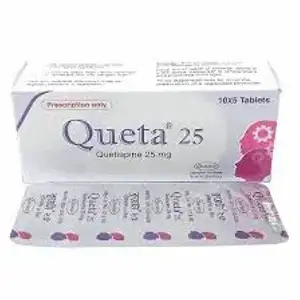
by Opsonin Pharma Limited
৳3.00