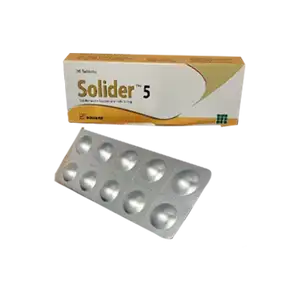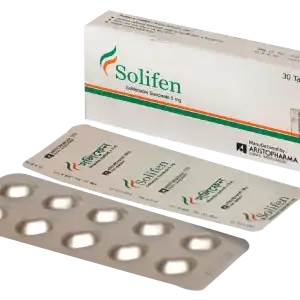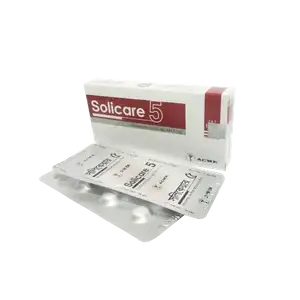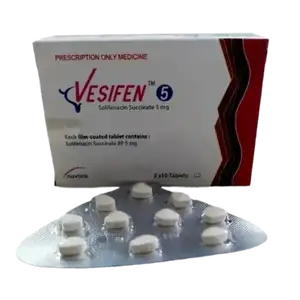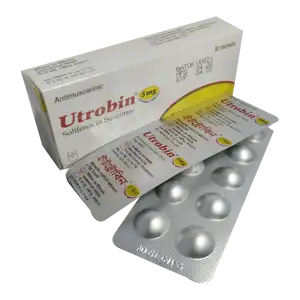
Utrobin 5 Tablet
by UniMed UniHealth Pharmaceuticals Ltd
৳20.00
Square Pharmaceuticals Limited

Treatment for urge incontinence and/or increased urinary frequency and urgency in patients with overactive bladder syndrome.
Solifenacin is a muscarinic receptor antagonist that is competitive. It binds to M3, M1, and M2 muscarinic receptors with the greatest affinity. M2 receptors account for 80% of muscarinic receptors in the bladder, while M3 receptors account for 20%. Antagonism of the M3 receptor by solifenacin prevents detrusor muscle contraction, while antagonism of the M2 receptor may prevent bladder smooth muscle contraction.
The recommended dose for adults and the elderly: Solifenacin Succinate 5 mg once daily. If needed, the dose may be increased to Solifenacin Succinate 10 mg once daily.
Use in children: Safety and effectiveness in children have not yet been established. Therefore, Solifenacin Succinate should not be used in children.
Concomitant pharmaceutical with other restorative items with anticholinergic properties may result in more articulated restorative impacts and undesirable impacts. An interim of around one week ought to be permitted after ceasing treatment with Solifenacin Succinate some time recently commencing other anticholinergic treatment. The helpful impact of Solifenacin may be diminished by concomitant organization of cholinergic receptor agonists. Solifenacin can decrease the impact of therapeutic items that fortify the motility of the gastrointestinal tract, such as Metoclopramide and Cisapride. In vitro considers have illustrated that at restorative concentrations, Solifenacin does not restrain CYP1A1/2, 2C9, 2C19, 2D6, or 3A4 determined from human liver microsomes. In this manner, Solifenacin is impossible to change the clearance of drugs metabolized by these CYP chemicals. Solifenacin is metabolized by CYP3A4. Concurrent organization of Ketoconazole (200 mg/day), a strong CYP3A4 inhibitor.
Solifenacin is contraindicated in patients with extreme touchiness to solifenacin or to any of the excipients. It is additionally contraindicated in myasthenia gravis, urinary maintenance, uncontrolled limit point glaucoma, serious gastro-intestinal condition (counting poisonous megacolon), patients experiencing haemodialysis, patients with serious hepatic impedance, patients with serious renal impedance or direct hepatic disability and on treatment with a solid CYP3A4 inhibitor, e.g. ketoconazole.
Due to the pharmacological impact of Solifenacin, it may cause anticholinergic undesirable impacts of (in common) gentle or direct seriousness. The recurrence of anticholinergic undesirable impacts is dosage related. The foremost commonly detailed antagonistic reactionwith Solifenacin is dry mouth. It happened in 11% of patients treated with 5 mg once day by day, in 22% of patients treated with 10 mg once every day and in 4% of placebo-treated patients. The seriousness of dry mouth was for the most part gentle and as it were once in a while driven to suspension of treatment. In general,medicinal item compliance was exceptionally tall (roughly 99%) and around 90% of the patients treated with Solifenacin completed the complete think about period of 12 weeks treatment. Gastrointestinal disarranges: exceptionally common- dry mouth, common-constipation, queasiness, dyspepsia, stomach torment, exceptional- gastroesophageal reflux illnesses, dry throat, uncommon- colonic obstacle, fecal impaction, exceptionally uncommon- vomiting. Infections and pervasions.
Omeprazole is classified as pregnancy category C by the US Food and Drug Administration. However, the findings of three prospective epidemiological studies show that Omeprazole has no negative effects on pregnancy or the health of the fetus/newborn child. There is no information on Omeprazole's entry into breast milk or its effects on the newborn. If the usage of Omeprazole is deemed necessary, breast-feeding should be terminated.
No clinical information are accessible from ladies who got to be pregnant whereas taking Solifenacin. Creature ponders don't demonstrate coordinate destructive impacts on ripeness, embryonal / fetal improvement or parturition. The potential chance for people is obscure. Caution ought to be worked out when endorsing to pregnant ladies. No information on the excretion of Solifenacin in human drain are accessible. In mice, Solifenacin and/or its metabolites was excreted in drain, and caused a dosage subordinate disappointment to flourish in neonatal mice. The utilize of Solifenacin ought to subsequently be dodged amid breast-feeding.
Other causes of visit urination (heart disappointment or renal infection) ought to be evaluated some time recently treatment with Solifenacin Succinate. In case urinary tract disease is display, an suitable antibacterial treatment ought to be begun. Solifenacin Succinate ought to be utilized with caution in patients with: clinically critical bladder outpouring obstacle at chance of urinary maintenance, gastrointestinal obstructive clutters, hazard of diminished gastrointestinal motility, extreme renal impedance (creatinine clearance 30 ml/min), direct hepatic impedance (Child-Pugh score of 7 to 9) and measurements ought to not surpass 5 mg for these patients.
Keep away from light and heat in a dry area. Keep out of children's reach.
Square Pharmaceuticals Ltd.
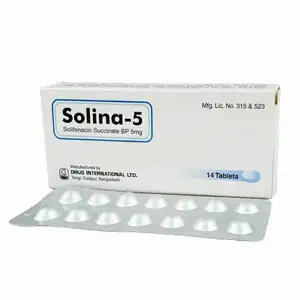
by Drug International Limited
৳14.00