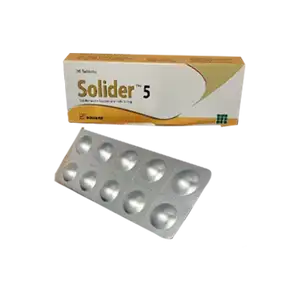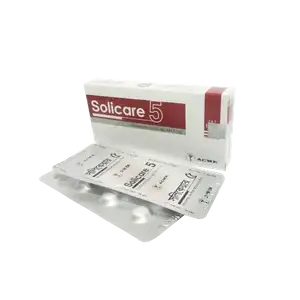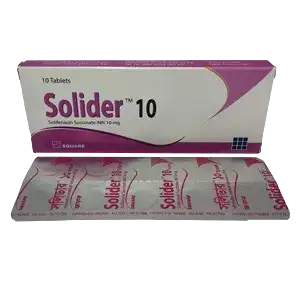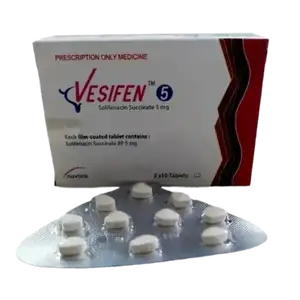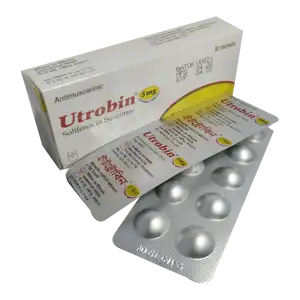
Utrobin 5 Tablet
by UniMed UniHealth Pharmaceuticals Ltd
৳20.00
Aristopharma Ltd.
Solifenacin Succinate
Treatment for urge incontinence and/or increased urine frequency and urgency in patients with overactive bladder syndrome.
Solifenacin is a muscarinic receptor antagonist that is competitive. It binds to M3, M1, and M2 muscarinic receptors with the greatest affinity. M2 receptors account for 80% of muscarinic receptors in the bladder, while M3 receptors account for 20%. Antagonism of the M3 receptor by solifenacin prevents detrusor muscle contraction, while antagonism of the M2 receptor may prevent bladder smooth muscle contraction.
Adults and the elderly should take 5 mg of Solifenacin Succinate once a day. If necessary, the dose can be increased to 10 mg of Solifenacin Succinate once a day.
Children's use: The safety and effectiveness of this product in children have yet to be determined. As a result, children should not be given Solifenacin Succinate.
Concurrent therapy with other anticholinergic medical drugs may result in more noticeable therapeutic results as well as unwanted side effects. After stopping Solifenacin Succinate treatment, a one-week delay should be given before starting any other anticholinergic medicine. Concomitant use of cholinergic receptor agonists may diminish the therapeutic impact of Solifenacin. Solifenacin can diminish the effects of drugs that increase gastrointestinal motility, such as Metoclopramide and Cisapride, in the body. Solifenacin does not inhibit CYP1A1/2, 2C9, 2C19, or 2D6 at therapeutic amounts, according to in vitro tests. 3A4 generated from human liver microsomes, for example. As a result, the clearance of medicines metabolized by these CYP enzymes is unlikely to be affected by Solifenacin. CYP3A4 is the enzyme that breaks down solifenacin. The AUC of Solifenacin was increased twofold when Ketoconazole (200 mg/day), a powerful CYP3A4 inhibitor, was given at the same time. The AUC of Solifenacin was increased thrice when Ketoconazole was given at a dose of 400 mg/day. When used in combination with Ketoconazole or therapeutic levels of other potent CYP3A4 inhibitors, the maximum dose of Solifenacin Succinate should be limited to 5 mg (e.g. Ritonavir, Nelfinavir, Itraconazole).
Patients with severe renal impairment or moderate hepatic impairment should not use Solifenacin and a powerful CYP3A4 inhibitor at the same time. The impact of enzyme induction on Solifenacin and its metabolites pharmacokinetics, as well as the influence of greater affinity CYP3A4 substrates on Solifenacin exposure, have not been investigated. Because Solifenacin is metabolized by CYP3A4, pharmacokinetic interactions with other CYP3A4 substrates (e.g. Verapamil, Diltiazem) and CYP3A4 inducers are possible (e.g. Rifampicin, Phenytoin, Carbamazepine).
Solifenacin's effect on the pharmacokinetics of other medicines:
Patients who are hypersensitive to solifenacin or any of the excipients should avoid using it. Myasthenia gravis, urine retention, uncontrolled narrow-angle glaucoma, and severe gastro-intestinal conditions are all contraindications (including toxic megacolon), Patients on hemodialysis, patients with severe hepatic impairment, patients with severe renal impairment, or patients with intermediate hepatic impairment who are using a strong CYP3A4 inhibitor, such as ketoconazole.
Solifenacin's pharmacological activity may result in anticholinergic side effects of mild to moderate severity (in general). The occurrence of anticholinergic side effects is dose-dependent. The most prevalent side effect associated with Solifenacin is dry mouth. It happened to 11% of individuals who were given 5 mg once a day. 22% of patients were given 10 mg once daily and 4% of patients were given a placebo. The severity of dry mouth was usually modest, and treatment was only stopped on rare occasions. In general, patient compliance with pharmaceutical products was quite high (about 99 percent), and roughly 90% of patients treated with Solifenacin completed the entire 12-week research term.
There are no clinical data on women who fell pregnant while taking Solifenacin. Fertility, embryonal/fetal development, and parturition have not been shown to be harmed in animal studies. Humans may be at risk, but this is unknown. Prescriptions for pregnant women should be handled with caution. There is no information on the excretion of Solifenacin in human milk. Solifenacin and/or its metabolites were excreted in mice's milk, causing newborn mice to fail to thrive in a dose-dependent manner. As a result, Solifenacin should not be used while breastfeeding.
Before starting treatment with Solifenacin Succinate, check for other causes of frequent urination, such as heart failure or renal illness. If you have a urinary tract infection, you should start antimicrobial treatment right away. In individuals with a clinically substantial bladder outflow obstruction at risk of urine retention, Solifenacin Succinate should be taken with caution. Gastrointestinal obstructive diseases, impaired gastrointestinal motility risk, severe renal impairment (creatinine clearance 30 ml/min), moderate hepatic impairment (Child-Pugh score of 7 to 9), and doses should not exceed 5 mg for these individuals. Concomitant usage of a powerful CYP3A4 inhibitor, such as ketoconazole, hiatus hernia/gastroesophageal reflux, and/or hiatus hernia/gastroesophageal reflux and/or hiatus hernia/gastroesophageal reflux and/or hiatus hernia/gastroesophageal reflux, should be approached with caution. Who is taking medications (such as bisphosphonates) that might cause or worsen oesophagitis and autonomic neuropathy at the same time? In patients with a neurogenic reason for detrusor overactivity, safety and efficacy have yet to be shown. Galactose intolerance is an uncommon inherited condition that affects a small number of people. This pharmaceutical product should not be used by people who have Lapp lactase insufficiency or glucose-galactose malabsorption. Solifenacin Succinate's maximum effect can be evaluated after 4 weeks at the earliest.
BPH/ Urinary retention/ Urinary incontinence, anticholinergics (antimuscarinics)/ antispasmodics, BPH/ Urinary retention/ Urinary incontinence.
Store in a cold, dry, and light-protected location.
Aristopharma Ltd
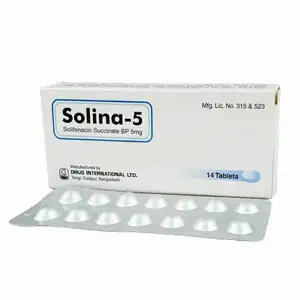
by Drug International Limited
৳14.00