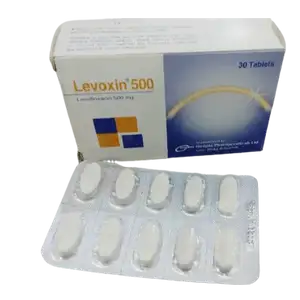
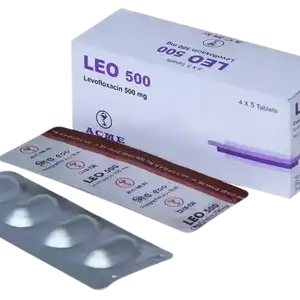
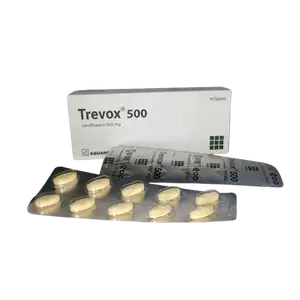
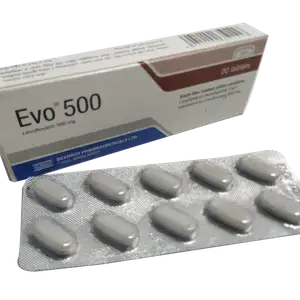
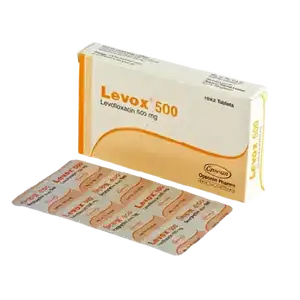
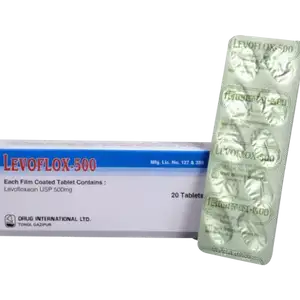
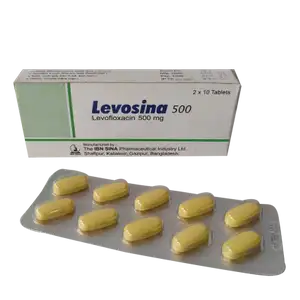
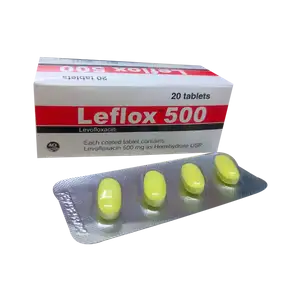
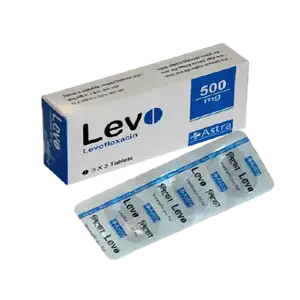
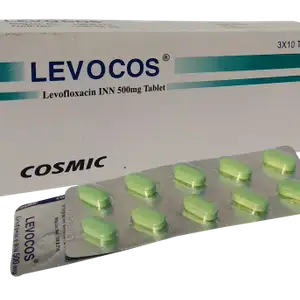
Generic
Levofloxacin Hemihydrate
Indications
Levofloxacin is indicated for the treatment of mild, moderate and severe infections caused by susceptible strains of the microorganisms specified under the conditions listed below:
- Acute maxillary sinusitis caused by Streptococcus pneumoniae, Haemophilus influenzae or Moraxella catarrhalis.
- Acute bacterial exacerbation of chronic bronchitis caused by Staphylococcus aureus, Streptococcus pneumoniae, Haemophilus influenzae or Moraxella catarrhalis.
- Community-acquired pneumonia caused by Staphylococcus aureus, Streptococcus pneumoniae, Haemophilus influenzae, Klebsiella pneumoniae, Moraxella catarrhalis, Chlamydia pneumoniae, Legionella pneumoniae or Mycoplasma pneumoniae.
- Uncomplicated and complicated urinary tract infections caused by Escherichia coli, Klebsiella pneumoniae or Staphylococcus saprophyticus.
- Acute pyelonephritis caused by Escherichia coli.
- Simple and complicated infections of the skin and soft tissues, including abscesses, cellulitis, boils, impetigo, pyoderma, wound infections caused by Staphylococcus aureus, Streptococcus pyogenes, Proteus mirabilis or Enterococcus faecalis.
- Intestinal infections caused by Enterobacter sp., Escherichia coli, Campylobacter sp., Vibrio cholerae, Shigella sp., Salmonella sp.
Pharmacology
Levofloxacin is a third generation, synthetic, broad-spectrum fluoroquinolone antibiotic. Chemically, levofloxacin is an asymmetric fluorinated carboxyquinolone. Levofloxacin exerts its antibacterial action by inhibiting bacterial topoisomerase IV and DNA gyrase, enzymes required for DNA replication, transcription repair, and recombination. It has in vitro activity against a wide range of gmve and gm+ve microorganisms.
Dosage
The usual dose of levofloxacin tablets is 250 mg or 500 mg or 750 mg orally every 24 hours. Levofloxacin tablets can be taken regardless of food. Levofloxacin oral solution should be taken 1 hour before or 2 hours after food.
Levofloxacin should be administered by intravenous infusion only. It should not be injected intramuscularly, intradermally, intraperitoneally or subcutaneously. The usual dose of Levofloxacin Injection is 250 mg or 500 mg as a slow infusion over 60 minutes every 24 hours or 750 mg as a slow infusion over 90 minutes every 24 hours. Since the levofloxacin injection is for single use only, any unused portion should be discarded. Additives or other drugs should not be added to Levofloxacin Injection or administered simultaneously by the same intravenous route.
Adults:
- Acute sinusitis: 500 mg once daily for 1014 days, or 750 mg once daily for 5 days
- Exacerbations of chronic bronchitis: 500 mg once daily for 7 days, or 750 mg x once / day for 3 days (), 750 mg x once / day for 5 days (complicated)
- Community-acquired pneumonia: 500 mg x once / day for 714 days, or 750 mg once daily for 5 days Uncomplicated UTIs: 250 mg once daily for 3 days
- Complicated urinary tract infections and acute pyelonephritis: 250 mg x once / day for 710 days
- Uncomplicated skin and soft tissue infections: 500 mg x once / day for 710 days.
- Complicated and sensitive skin infections: 750 mg once / day for 714 days.
- Irritability: 500 mg x once / day for 714 days.
- Diarrhea, cholera, shigellosis and enteritis: Mild to moderate cases: 500 mg (single dose). Moderate to severe cases: 500 mg once daily for 3 days
Children:
- Children 6 months to 5 years: 10 mg / kg every 24 hours
In each case, sequential therapy (injection) intravenous to oral) may be performed at the discretion of the physician.
Administration
Levofloxacin infusion instructions
- Check the container for minimal leakage by squeezing the inner pouch firmly. If a leak is found or the seal is not intact, discard the solution.
- Do not use if solution becomes cloudy or precipitates.
- Do not use flexible containers in serial connections.
- Close the flow control clamp of the manager.
- Remove the port cover at the bottom of the container.
- Insert the through pin of the manager into the gate by making a twisting motion until the latch is securely fastened.
- Hang the container on the hanger.
- Squeeze and release the drip chamber to establish the correct level of fluid in the chamber when administering Levoxin Injection.
- Open the flow control clamp to expel air from the unit. Close clamp.
- Adjust the delivery speed with the speed control clamp.
Interaction
Quinolones should not be administered concomitantly with solutions containing multivalent cations, e.g. magnesium, by the same intravenous route. Antacids, iron and adsorbents reduce the absorption of levofloxacin. NSAIDs may increase the risk of CNS irritation. Warfarin may increase the risk of bleeding.
Contraindications
Levofloxacin is contraindicated in patients with a history of hypersensitivity to levofloxacin, quinolone antibacterial agents or any other ingredient of this product.
Side Effect
Levofloxacin is generally well tolerated. However, some side effects can often be seen. There is a risk of retinal detachment. Other side effects include: nausea, vomiting, diarrhea, abdominal pain, flatulence and, in rare cases, phototoxicity (0.1%). Side effects that can be seen very rarely include tremors, depression, anxiety, confusion, etc.
Pregnancy & Lactation
Levofloxacin is not recommended during pregnancy or lactation because the effect on the fetus or neonate is unknown.
Precautions & Warnings
The following should be taken while using Levofloxacin:
- Levofloxacin Injection should only be taken by slow intravenous infusion over a period of 60 or 90 minutes depending on the dose.
- When using levofloxacin, it is advisable to drink sufficient amounts of water to avoid concentrated urine.
- Dose adjustment should be made during administration of levofloxacin in the presence of renal impairment.
Therapeutic Class
4-Quinolone preparations
Storage Conditions
Keep below 30°C temperature, away from light & moisture. Keep out of the reach of children.
Pharmaceutical Name
Cosmo Pharma Ltd.