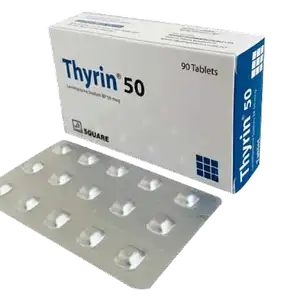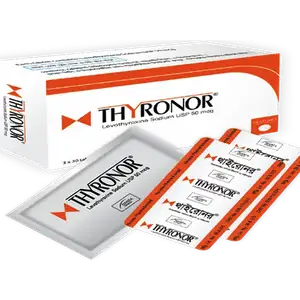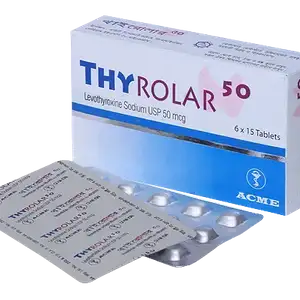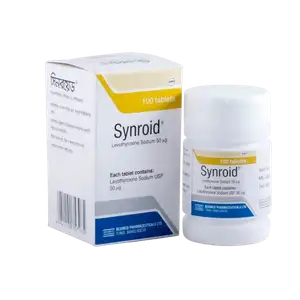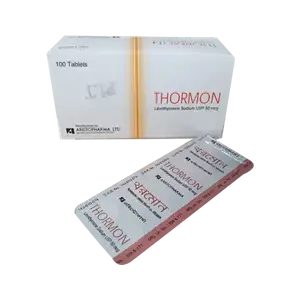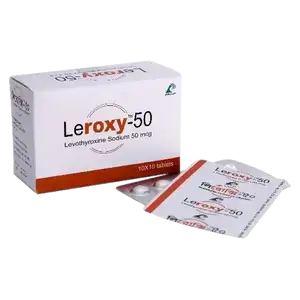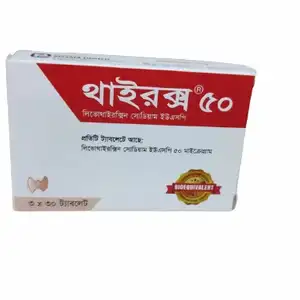
Thyrox 50 Tablet
by Renata Pharma Ltd
৳2.20
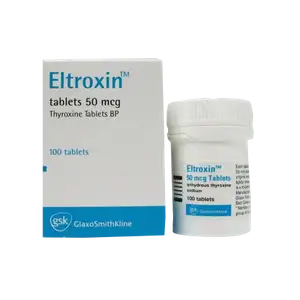
GlaxoSmithKline Bangladesh Limited
Levothyroxine Sodium
This pill includes synthetic Levothyroxine (commonly known as Thyroxine or T4), which is the same as the natural hormone T4, which is generated in the thyroid gland. In peripheral tissues, approximately 30% of T4 is transformed to the considerably more active Triiodothyronine (T3). TBG (Thyroxine Binding Globulin) is the primary T4 carrier. Because of this binding, T4 is protected from metabolism and elimination, resulting in a lengthy half-life in the circulation. Unbound T4 accounts for just around 0.03 percent of total T4 in plasma. T4 elimination has a half-life of 6 to 7 days. The half-life in hyperthyroidism is 3 or 4 days, but in hypothyroidism it might be 9 to 10 days. T4 half-life may be decreased in situations associated with low protein in plasma, such as nephrosis or hepatic cirrhosis, or when binding to protein is blocked by specific medications. Thyroid hormones are mostly degraded in the liver. T4 is eliminated in the urine after being conjugated with Glucuronic and Sulphate conjugates through the Phenolic hydroxyl group. Thyroid hormones circulate via the enterohepatic system because they are hydrolyzed and reabsorbed in the gut. Because of T4's extended half-life, a single daily dosage of Levothyroxine can provide a consistent blood level of the physiologically more active T3. As a result, once the right dosage has been identified, changes in the therapeutic impact are uncommon.
Adult dose:
Pediatric Dosage Newborns: The recommended starting dose is 10-15 meg/kg/day. A lower starting dose should be considered in infants at risk for cardiac failure and the dose should be increased in 4-6 weeks as needed based on clinical and laboratory response to treatment. In infants with very low (<5 mcg/dL) or undetectable serum T4 concentrations, the recommended initial starting dose is 50 meg/day of Levothyroxine Sodium.
Infants and Children: In children with chronic or severe hypothyroidism, initial dose of 25 meg/day with increments of 25 meg every 2-4 weeks until the desired effect is achieved. Hyperactivity in an older child can be minimized if the starting dose is one-fourth of the recommended full replacement dose and the dose is then increased on a weekly basis by an amount equal to one-fourth the full recommended replacement dose until the full recommended replacement dose is reached.
The dose should be adjusted based on clinical response and laboratory parameters. In the treatment of goitres, nodules and Thyroid cancer, the objective is to ensure a constant and sufficient suppression of TSH. For suppression of TSH levels, a gradual increase in dosing is usually not necessary. For adults, the usual suppressive dosage of T4 is 2.6 meg/kg of body weight daily. When Levothyroxine Sodium is used as a diagnostic aid, the dosage depends on the type of investigation.
Concurrent use of thyroid hormones with any of the following medications or substances may result in clinically significant interactions:
Acute Myocardial Infarction, Uncorrected Adrenal Failure, Untreated Subclinical or Overt Thyrotoxicosis of Any Etiology.
A high dose may cause hyperthyroidism symptoms such as tachycardia, anxiety, tremor, headache, flushing, sweat, and weight loss. If required, therapy might be stopped for a few days and then restarted at a reduced dose.
Pregnancy Type A. Pregnancy may increase the need for Levothyroxine. Although thyroid hormones are relatively little excreted in human milk, care should be used when administering it to a breastfeeding mother. However, sufficient Levothyroxine replacement dosages are typically required to ensure normal lactation.
Thyroid medications and hormones
Keep cool and dry, and keep away from direct sunlight. Keep out of children's reach.
Glaxo Smithkline Bangladesh Limited
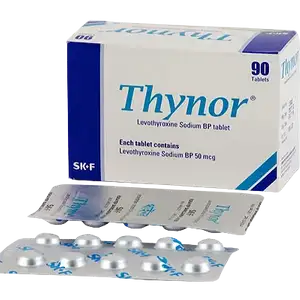
by SK+F
৳2.00