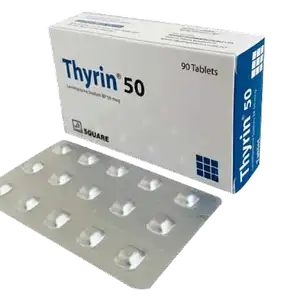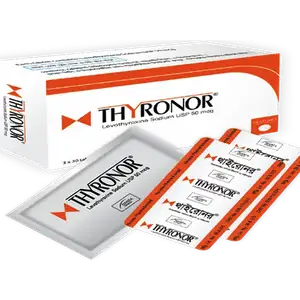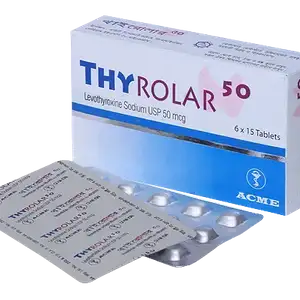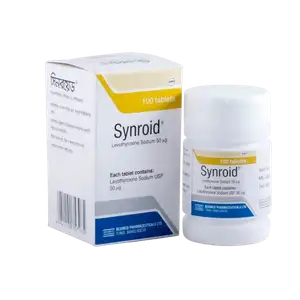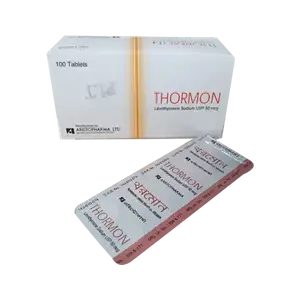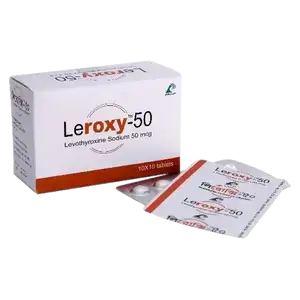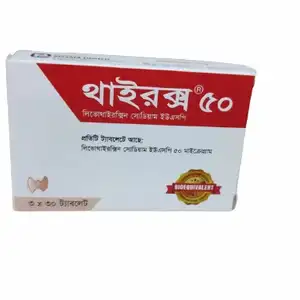
Thyrox 50 Tablet
by Renata Pharma Ltd
৳2.20
SK+F
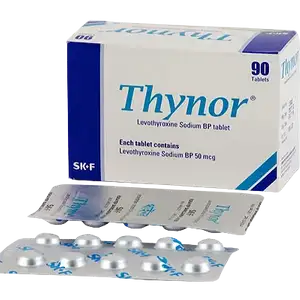
Levothyroxine Sodium
Expanded Angina and/or Myocardial Dead tissue Once in a while, patients, especially those with extreme obstructive coronary supply route illness, have created recorded expanded recurrence, length and/or seriousness of angina or intense myocardial dead tissue on beginning calcium channel blocker treatment or at the time of dose increment. The instrument of this impact has not been illustrated. Liver Brokenness. HMG-CoA reductase inhibitors, like a few other lipid-lowering treatments, have been related with biochemical variations from the norm of liver function.
In conditions related with decreased protein in plasma as in nephrosis or hepatic cirrhosis or when authoritative to protein is repressed by certain drugs the half-life of T4 may be abbreviated. The liver is the major location of corruption of Thyroid hormones. T4 is conjugated with Glucuronic and Sulfate conjugates through the Phenolic hydroxyl bunch and excreted within the urine.There is an enterohepatic circulation of the Thyroid hormones, since they are liberated by hydrolysis within the digestive system and reabsorbed. Since of the long half-life of T4, a relentless blood level of the organically more dynamic T3 can be gotten from one single every day measurements of Levothyroxine. In this manner, variations within the helpful impact are impossible once the proper measurement has been set up.
Adult dose:
Initial starting dose: 25-50 meg/day, with gradual increments in dose at 6-8 week intervals, as needed. The Levothyroxine Sodium dose is generally adjusted in 12.5-25 meg increments until the patient with primary hypothyroidism is clinically euthyroid and the serum TSH has normalized.
In patients with severe hypothyroidism: Initial dose is 12.5-25 meg/day with increases of 25 meg/day every 2-4 weeks, accompanied by clinical and laboratory assessment,until the TSH level is normalized.
In patients with secondary (pituitary) or tertiary (hypothalamic)
hypothyroidism: Levothyroxine Sodium dose should be titrated until the patient is clinically euthyroid and the serum free - T4 level is restored to the upper half of the normal range.
For patients older than 50 years or for patients under 50 years of age with underlying cardiac disease: 1.7 meg/kg/day.
Pediatric Dosage Newborns: The recommended starting dose is 10-15 meg/kg/day. A lower starting dose should be considered in infants at risk for cardiac failure and the dose should be increased in 4-6 weeks as needed based on clinical and laboratory response to treatment. In infants with very low (<5 mcg/dL) or undetectable serum T4 concentrations, the recommended initial starting dose is 50 meg/day of Levothyroxine Sodium.
Infants and Children: In children with chronic or severe hypothyroidism, initial dose of 25 meg/day with increments of 25 meg every 2-4 weeks until the desired effect is achieved. Hyperactivity in an older child can be minimized if the starting dose is one-fourth of the recommended full replacement dose and the dose is then increased on a weekly basis by an amount equal to one-fourth the full recommended replacement dose until the full recommended replacement dose is reached.
0-3 months: 10-15 meg/kg/day
3-6 months: 8-10 meg/kg/day
6-12 months: 6-8 meg/kg/day
1-5 years: 5-6 meg/kg/day
6-12 years: 4-5 meg/kg/day
>12 years but growth and puberty incomplete: 2-3 meg/kg/day
Growth and puberty complete: 1.7 meg/kg/day.
The dose should be adjusted based on clinical response and laboratory parameters. In the treatment of goitres, nodules and Thyroid cancer, the objective is to ensure a constant and sufficient suppression of TSH. For suppression of TSH levels, a gradual increase in dosing is usually not necessary. For adults, the usual suppressive dosage of T4 is 2.6 meg/kg of body weight daily. When Levothyroxine Sodium is used as a diagnostic aid, the dosage depends on the type of investigation.
Thyroid hormones taken together with any of the following medicines or substances may cause clinically significant interactions:
Oral anticoagulants: Thyroid hormones may help oral anticoagulants work better.
Anti-diabetic drugs: Thyroid hormones can increase the need for insulin or oral hypoglycemic medications.
Digitalis preparations: Thyroid hormones may change the amount of Digitalis you need.
Cholestyramine: Cholestyramine may reduce the absorption of thyroid hormones; consequently, there should be at least a 4-hour gap between administrations.
Phenytoin: Phenytoin appears to improve thyroid hormone metabolism and may displace T4 from TBG.
Foods: To avoid uneven absorption, Levothyroxine pills should be taken on an empty stomach with some fluids at a set time. T4 absorption may be reduced if food is consumed at the same time.
Acute Myocardial Infarction, Uncorrected Adrenal Failure, Untreated preclinical or overt Thyrotoxicosis of any origin
Overdosing can cause hyperthyroidism symptoms as tachycardia, agitation, tremor, headache, flushing, perspiration, and weight loss. Treatment can be stopped for a few days and then resumed at a lower dose if necessary.
Category A Pregnancy. The need for Levothyroxine may increase during pregnancy. Although thyroid hormones are excreted in small amounts in human milk, caution should be maintained when given to a nursing mother. To maintain regular lactation, however, appropriate replacement doses of Levothyroxine are usually required.
Thyroid drugs & hormone.
Store in a cool and dry place, protect from light. Keep out of the reach of children.
Eskayef Pharmaceuticals Ltd.
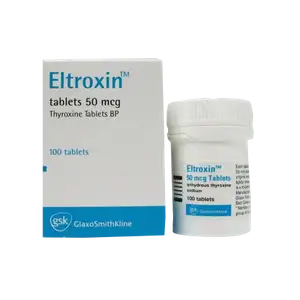
by GlaxoSmithKline Bangladesh Limited
৳255.60