Nexcital 5 Tablet
by UniMed UniHealth Pharmaceuticals Ltd
৳8.00
SK+F
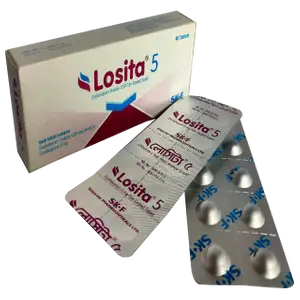
Losita 5 from SK-F Pharmaceuticals Limited & Generic is Escitalopram 5mg. Escitalopram Oxalate is indicated in the treatment of Major depressive episodes, Generalised anxiety disorder, Obsessive-compulsive disorder, Panic disorder with or without agoraphobia & Social anxiety disorder (social phobia).
Escitalopram Oxalate is recommended in the-
Escitalopram is a selective serotonin reuptake inhibitor that is used orally (SSRI). The pure S-enantiomer of the racemic bicyclic phthalate derivative citalopram is escitalopram. When it comes to inhibiting 5-HT reuptake, escitalopram is at least 100 times more powerful than the R-enantiomer. Escitalopram has no or poor affinity for serotonergic and other receptors, such as alpha- and beta-adrenergic Dopamine, Histamine, Muscarinic, and benzodiazepine receptors.
Safety of daily doses above 20 mg has not been demonstrated. Escitalopram Oxalate is administered as a single daily dose and may be taken with or without food.
Major depressive episodes: Usual dosage is 10 mg once daily. Depending on individual patient response, the dose may be increased to a maximum of 20 mg daily. Usually, 2-4 weeks are necessary to obtain an antidepressant response. After the symptoms resolve, treatment for at least 6 months is required for consolidation of the response.
Panic disorder with or without agoraphobia: An initial dose of 5 mg is recommended for the first week before increasing the dose to 10 mg daily. The dose may be further increased, up to a maximum of 20 mg daily, dependent on individual patient response. Maximum effectiveness is reached after about 3 months. The treatment lasts several months.
Social anxiety disorder: Usual dosage is 10 mg once daily. Usually, 2-4 weeks are necessary to obtain symptom relief. The dose may subsequently, depending on individual patient response, be decreased to 5 mg or increased to a maximum of 20 mg daily. Social anxiety disorder is a disease with a chronic course, and treatment for 12 weeks is recommended to consolidate response. Long-term treatment of responders has been studied for 6 months and can be considered on an individual basis to prevent relapse; treatment benefits should be re-evaluated at regular intervals. Social anxiety disorder is a well-defined diagnostic terminology of a specific disorder, which should not be confounded with excessive shyness. Pharmacotherapy is only indicated if the disorder interferes significantly with professional and social activities. The place of this treatment compared to cognitive behavioural therapy has not been assessed. Pharmacotherapy is part of an overall therapeutic strategy.
Generalised anxiety disorder: Initial dosage is 10 mg once daily. Depending on the individual patient response, the dose may be increased to a maximum of 20 mg daily. Long term treatment of responders has been studied for at least 6 months in patients receiving 20 mg/day. Treatment benefits and dose should be re-evaluated at regular intervals.
Obsessive-Compulsive Disorder: Initial dosage is 10 mg once daily. Depending on the individual patient response, the dose may be increased to a maximum of 20 mg daily. As OCD is a chronic disease, patients should be treated for a sufficient period to ensure that they are symptom-free. Treatment benefits and dose should be re-evaluated at regular intervals.
Escitalopram should be taken once a day, in the morning or evening, with or without meals.
Antidepressants such as SSRIs and related antidepressants should not be begun for at least two weeks after discontinuing an MAOI. An MAOI, on the other hand, should not be used. begun until at least a week after you've finished taking an SSRI or similar antidepressant (2 weeks in the case of paroxetine and sertraline, at least 5 weeks in the case of fluoxetine).
Escitalopram is not recommended for patients who have a known hypersensitivity to Escitalopram, Citalopram, or any of the drug's inactive components. It's not a good idea to take escitalopram and monoamine oxidase/pimozide at the same time.
SSRIs are less sedating than tricyclic antidepressants and have fewer antimuscarinic and cardiotoxic effects. SSRIs can cause gastrointestinal problems (nausea, vomiting, dyspepsia, stomach discomfort, diarrhoea, and constipation are all dose-related and very frequent), as well as anorexia and weight loss (increased appetite and weight gain also reported) Other side effects include dry mouth, nervousness, anxiety, headache, insomnia, tremor, dizziness, asthenia, hallucinations, drowsiness, convulsions, galactorrhoea, sexual dysfunction, urinary retention, sweating, hypomania or mania, movement disorders, and dyskinesias; and hypersensitivity reactions such as rash, urticaria, angioedema, anaphylaxis, arthralgia.
The hazards and advantages of treating a pregnant woman with Escitalopram throughout the third trimester should be carefully considered by the physician. It's passed through human breast milk. The danger of citalopram exposure for the newborn and the advantages of Escitalopram treatment should be considered when deciding whether to continue or stop breastfeeding or Escitalopram medication.
In patients with epilepsy (avoid if poorly controlled, discontinue if convulsions develop), concurrent electroconvulsive therapy, history of mania, cardiac disease, diabetes mellitus, angle-closure glaucoma, concomitant use of drugs that increase bleeding risk, history of bleeding disorders, hepatic and renal impairment, SSRIs should be used with caution.
SSRIs & related anti-depressant drugs
Keep away from light and heat in a dry area. Keep out of children's reach.
by Sun Pharmaceutical Industries Ltd.
৳6.50