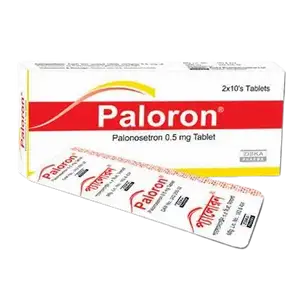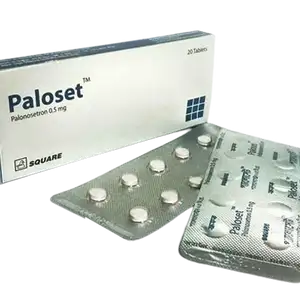
Paloxi 0.5 Tablet
by Beacon Pharmaceuticals Limited
৳20.06
Popular Pharmaceuticals Ltd.
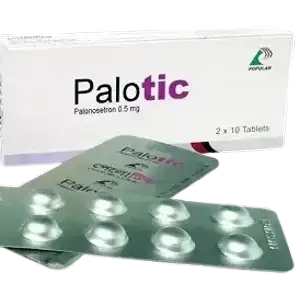
Palonosetron
Palonosetron is an antagonist of the 5HT3 receptor, which has a strong binding affinity for this receptor, but little or no affinity for other receptors. Chemotherapy drugs are believed to cause nausea and vomiting by releasing serotonin from the enterochromaffin cells of the small intestine, and then the released serotonin activates the 5HT3 receptor postem area located in the peripheral vagus nerve endings and the chemoreceptor trigger area to initiate the vomiting reflex. . Postoperative nausea and vomiting are affected by multiple factors related to the patient, surgery, and anesthesia, and are triggered by the release of 5HT3 in a series of neuronal events involving the central nervous system and the gastrointestinal tract. 5HT3 receptors have been shown to participate selectively in the emetic response. Palonosetron works by blocking the action of serotonin, which is associated with nausea and vomiting, at the 5HT receptors. Palonosetron likely works in the small intestine, but it can also work in the brain.
Pharmacokinetics: Palonosetron exhibited linear dose-relationship pharmacokinetics in healthy subjects and cancer patients within a dose range of 190 pg / kg. In cancer patients who received a single intravenous injection of palonosetron within this dose range, the mean maximum plasma concentration (Cmax) ranged from 0.89 to 336 ng / ml, and the area under the plasma concentration-time curve ranged from zero to infinity (AUCoco) is 13.8 to 957 ng.h / ml. The volume of distribution of Palonosetron is approximately 6.97.9 L / kg and approximately 62% is bound to plasma proteins. Approximately 50% of Palonosetron is metabolized to two inactive metabolites, showing <1% 5HT3 receptor antagonist activity. About 40% of the drugs are metabolized by the kidneys, and 50% are metabolized by the CYP2D6 isoenzymes (mainly), CYP3A4 and CYP1A2 in the liver. Approximately 50% of the drug is metabolized. After a single intravenous administration, about 40% of the drug is excreted in the urine as the original drug after 144 hours. In healthy subjects, the systemic clearance rate of palonosetron was 160 ± 35 ml / h / kg, and the renal clearance rate was 66.5 ± 18.2 ml / h / kg. Palonosetron has a longer half-life (40 hours) and a higher binding affinity for 5HT3 receptors.
Usual dosage: Adult tablet dosage: 0.5 mg daily. Adult IV dosage: A single IV dose of 0.075 mg should be administered over 10 seconds.
Chemotherapy-induced nausea and vomiting: Adult tablet dosage: 0.5 mg administered approximately 1 hour prior to the start of chemotherapy. Adult IV dosage: A single IV dose of 0.25 mg should be administered over 30 seconds approximately 30 minutes before the start of chemotherapy.
Radiotherapy-induced nausea and vomiting: A single IV dose of 0.25 mg should be administered over 30 seconds approximately 30 minutes before each week of radiation fraction.
Post-operative nausea and vomiting: A single IV dose of 0.075 mg should be administered over 10 seconds immediately before induction of anesthesia.
Children dosage: (1 month to 17 years): A single IV dose at 20 mcg/kg body weight. Which maximum dose is 1.5 mg.
In controlled clinical trials, palonosetron injection was administered safely with corticosteroids, analgesics, antiemetics / antinauseas, antispasmodics, and anticholinergics. In murine tumor models, Palonosetron did not inhibit the antitumor activity of cisplatin, cyclophosphamide, cytarabine, doxorubicin, and mitomycin C. There was no significant pharmacokinetic interaction between palonosetron and metoclopramide at the same time. In vitro studies have shown that palonosetron is not an inhibitor of CYP1A2, CYP2A6, CYP2B6, CYP2C9, CYP2D6, CYP2E1, and CYP3A4 / 5 (CYP2C19 has not been studied), nor does it induce CYP1A2, CYP2D6, or CYP3A4 activity. therefore, the possibility of clinically significant drug interactions with Palonosetron appears to be very low.
Palonosetron is contraindicated in patients known to have hypersensitivity to the drug or any of its components.
The most common adverse reactions are headaches and constipation.
Pregnancy category 'B'. It is not known whether Palonosetron is excreted in breast milk.
Anti-emetic drugs
Store in a cool & dry place, protected from light.
Popular Pharmaceuticals Ltd.