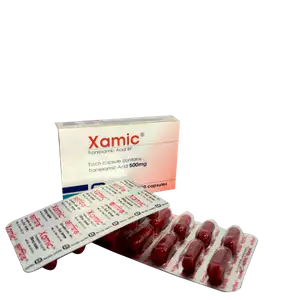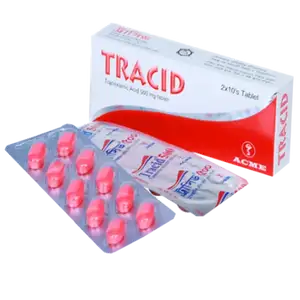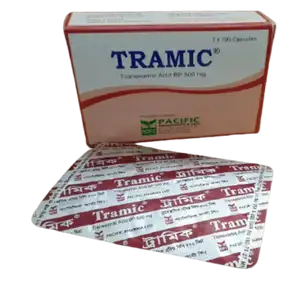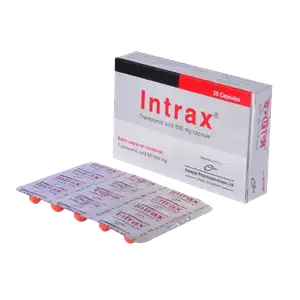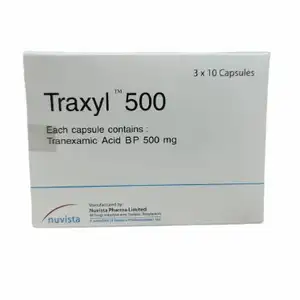
Traxyl 500 Capsule
by Nuvista Pharma Limited
৳25.00
Square Pharmaceuticals Limited

Tranexamic Acid
In medicine, hemophtoes, digestive hemorrhages, hemorrhagic syndromes in leukaemia, cirrhosis, and hemophilia, thrombocytopenic purpura, and mishaps during thrombolytic treatment and transfusion are all treated.
Prophylaxis and antihemorrhagic treatment for many types of procedures, notably pulmonary, cardiovascular, and abdominal surgery, as well as post-operative and traumatic shock.
Prophylaxis and antihemorrhagic treatment for prostatic, vesical, and renal surgery in urology. Hematurias.
In obstetrics, prophylaxis and treatment of post-partum and puerperium hemorrhages, hemorrhagic metrophathies, functional menometrorrhagias, idiopathic or IUD-induced menorrhagias, primitive hyperfibrinolysis (abruptio placentae, premature placenta separation), and cervical conization.
Prophylaxis and antihemorrhagic treatment after a tonsillectomy, specialized surgery in general, epistaxis are all examples of otorhinolaryngology.
In stomatology, prophylaxis and antihemorrhagic treatment are used during maxillofacial procedures, such as tooth extractions.
In oncology (as a form of supportive therapy): To stimulate the development of a fibrin capsule that would act as a barrier, inhibiting the growth of ovarian tumors. To produce ascites regression as a result of malignancy. To decrease bleeding during surgical procedures.
Tranexamic Acid has a strong inhibitory effect on the activation of plasminogen, i.e. the conversion of plasminogen to plasmin, in the fibrinolytic system. The half life is 1-2 hours. Plasma protein binding is 3% at therapeutic plasma levels. Tranexamic acid is rapidly absorbed from the gastrointestinal tract. Maximum serum levels are reached within 2-3 hours.
Intravenous administration is necessary only if it is difficult to give adequate doses by mouth. The recommended standard dose is 1 to 1.5 gm or 5-10 ml by slow intravenous injection at a rate of 1ml/minute, two to three times daily.
For the indications listed below the following doses are recommended.
Prostatectomy: 5-10 ml by slow intravenous injection every eight hours (the first injection being given during the operation) for the first three days after surgery; thereafter 1-1.5 gm orally three to four times daily until macroscopic haematuria is no longer present.
Menorrhagia: 1-1.5 gm orally three to four times daily for three to four days.
Epistaxis: 1.5 gm orally three times daily for four to ten days. Tranexamic Acid may be applied topically to the nasal mucosa of patients suffering from epistaxis. This can be done by soaking a gauze strip in the solution, and then packing the nasal cavity.
Haematuria: 1-1.5 gm orally 2-3 times daily until macroscopic haematuria is no longer present.
Conisation of the Cervix: 1.5 gm orally 3 times a day for 12 to 14 days post-operatively.
Dental Surgery In Patients With Coagulopathy: Immediately before surgery, 10 mg per kg body-weight should be given intravenously. After surgery, 25 mg per kg body-weight is given orally three to four times daily for six to eight days. Coagulation factor concentrate might be necessary to administrate.
General Fibrinolysis: 1.0 gm (10 ml) by slow intravenous injection three to four times daily. With fibrinolysis in conjunction with diagnosed, increased intravascular coagulation i.e. defibrillation syndrome, an anticoagulant such as heparin may be given with caution.
Hereditary Angioneurotic Oedema: 1-1.5 gm orally two to three times daily as intermittent or continuous treatment depending on whether the patient has prodromal symptoms or not.
Renal Insufficiency: For patients with impaired renal function, the following dosages are recommended: Serum creatinine Dose IV Dose Orally Dose frequency (micromol/L) 120-249 10 mg/kg 15 mg/kg twice daily 250-500 10 mg/kg 15 mg/kg daily >500 5 mg/kg 7.5mg/kg daily
Children:
Oral dose: 25 mg/kg 2 to 3 times daily for 7 to 10 days.
Injection: 10 mg/kg 6 to 8 hours for 7 to 10 days
Active thromboembolic disease, such as deep vein thrombosis, pulmonary embolism and cerebral thrombosis, Subarachnoid haemorrhage. Hypersensitivity to Tranexamic Acid or any of the ingredients
US FDA pregnancy category B. Tranexamic Acid crosses the placenta. Clinical experience of use in pregnant women is limited. Animal studies have not supplied any evidence of an increased incidence of foetal damage. Tranexamic Acid is excreted into breast milk, but it is not likely to influence the child at therapeutic doses.
Patients with irregular menstrual bleeding, patients with a high risk of thrombosis (a previous thromboembolic event and a family history of thromboembolic disease) should use it only if there is a strong medical indication and under strict medical supervision. Patients with disseminated intravascular coagulation (DIC), who require treatment with it must be under the strict supervision of a physician experienced in treating this disorder. In the long-term treatment of patients, regular eye examination should be performed. If a colour vision disorder should occur during the course of treatment, the drug should be discontinued.
Anti-fibrinolytic drugs, Haemostatic drugs
Store in a dry put at 15-30°C, absent from light and keep out of children's reach.
Square Pharmaceuticals Ltd.
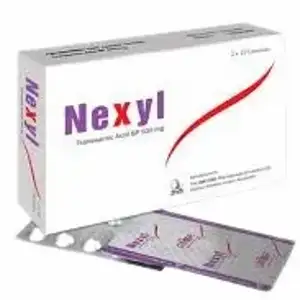
by The IBN SINA Pharmaceutical Industry Ltd.
৳15.00