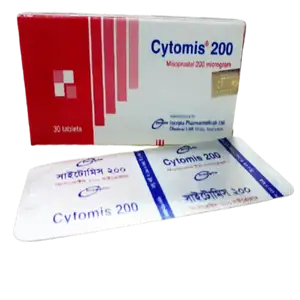
Cytomis 200 Tablet
by Incepta Pharmaceuticals Ltd
৳15.00
Gonoshasthaya Pharmaceuticals Ltd.

Misoprostol
Misoprostol is used to prevent stomach and duodenal ulcers in NSAID users who are at high risk of gastric ulcer complications, such as the elderly, patients with disabling disease, and patients with a history of ulcer.
Misoprostol is rapidly absorbed and de-esterified to its free acid, which is responsible for its therapeutic efficacy and is detectable in plasma, unlike the parent molecule. When taken with food, maximum plasma concentrations of Misoprostol acid are reduced, and overall availability of Misoprostol acid is reduced when an antacid is taken at the same time. Misoprostol possesses antisecretory (gastric acid secretion inhibition) and mucosal protecting effects in animals. NSAIDs limit prostaglandin synthesis, and a lack of prostaglandins in the gastric mucosa can cause decreased bicarbonate and mucus output, as well as mucosal injury.
Benign gastric and duodenal ulceration and NSAID associated ulceration: 800 meg daily (in 2-4 divided doses) with breakfast or main meals and at bedtime; treatment should be continued for at least 4 weeks and may be continued for up to 8 weeks if required.
Prophylaxis of NSAID-induced gastric and duodenal ulcer: 200 meg 2-4 times daily taken with NSAID. If this dose cannot be tolerated, a dose of 100 meg can be used. Misoprostol should be taken for the duration of NSAID therapy as prescribed by the physician.
Induction of labor: Place 25 meg in the posterior fornix of the vagina. Repeat after every 6 hours if necessary until the maximum dosage of 200 meg total misoprostol is reached. Fetal heart rate and uterus contractions should be monitored. Alternatively, 100 meg taken orally. If cervical ripening or active labor does not occur, repeated dose of 100-200 meg of oral misoprostol is given every 4 hourly until labor is established (as evidenced by a Bishop score of 7 or more). Maximum number of dose is 6. Maternal vital signs, fetal heart rate and contractions should be monitored. Oxytocin can be started 4 hours after last dose of misoprostol. Physician should be notified for signs of fetal distress or tetanic uterine contractions. Oral misoprostol therapy should be monitored by Physician.
Prevention of postpartum hemorrhage: 600 meg orally immediately following delivery.
Treatment of postpartum hemorrhage: 600 meg orally or 1000 meg per rectally.
There is no evidence that Misoprostol interacts with cardiac, pulmonary, CNS, or NSAID medications in a clinically meaningful way. With high doses of antacid, Misoprostol bioavailability is reduced.
Misoprostol is not recommended for anyone who has had a previous reaction to prostaglandins, and it is also not recommended during pregnancy.
Misoprostol is generally well tolerated. The GI tract is the most common side effect of Misoprostol therapy, with diarrhea, stomach discomfort, dyspepsia, flatulence, nausea, vomiting, rashes, and dizziness being the most common. The risk of diarrhea can be reduced by taking the medication after a meal and before bedtime, and by not taking it with a magnesium-containing or other laxative antacid.
It is not recommended for pregnant women due to the abortifacient characteristic of the Misoprostol component. It should not be used in women of reproductive age unless the patient requires nonsteroidal anti-inflammatory drug (NSAID) therapy and is at high risk of developing gastric or duodenal ulceration or complications from gastric or duodenal ulcers. It may be prescribed in such cases if the patient has had a negative serum pregnancy test during the previous two weeks.
In case of prevention and treatment of NSAID induced gastric and duodenal ulcer: Misoprostol is contraindicated in women who are pregnant, and should not be used in women of child bearing potential unless the patient requires NSAID therapy. Women of child bearing potential should be told that they must not be pregnant when Misoprostol therapy is initiated and they must use an effective contraception method while taking misoprostol.
In case of induction of labor: The pregnancy should have completed 38 weeks gestation by reliable dating, or lung maturity as evidenced by a L/S >2.0 or a positive phosphotidyl glycerol test, or completed 36 weeks gestation with a maternal or fetal medical indication for induction of labor. Induction of labor is contraindicated in acute fetal distress, abruptio placenta, placenta previa or unexplained vaginal bleeding. The fetus should be in vertex presentation.
Drugs acting on the Uterus, Prostaglandin analogues
Keep the temperature below 30°C and away from light and moisture. Keep out of children's reach.
Gonoshasthaya Pharma Ltd.
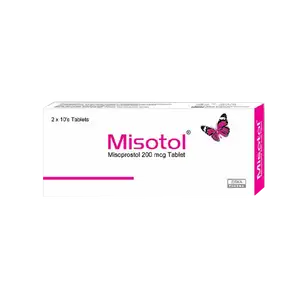
by Ziska Pharmaceuticals Limited
৳15.00